Your Venture Debt Is Not Runway. It Is a Deadline With Interest.
Venture debt can stretch capital — or it can convert a funding gap into a timed repayment problem. Founders must treat venture debt as a liability with a calendar: it follows equity, carries repayment schedules and covenants, and is evidence‑grounded in how startups actually finance themselves.

This editorial is evidence-led analysis, not investment, legal, accounting, or tax advice.
The decision
Treat venture debt as a deadline with interest, not as extra runway. The available evidence shows venture debt often follows equity, is sized as a fraction of the preceding equity round, and carries multi-year repayment schedules and covenant risks. The practical choice for a founder is binary: use venture debt only if the business can reliably reach a fundable milestone before repayment pressure binds; otherwise, using debt to rescue a broken financing plan converts a funding problem into a timing problem with covenants.
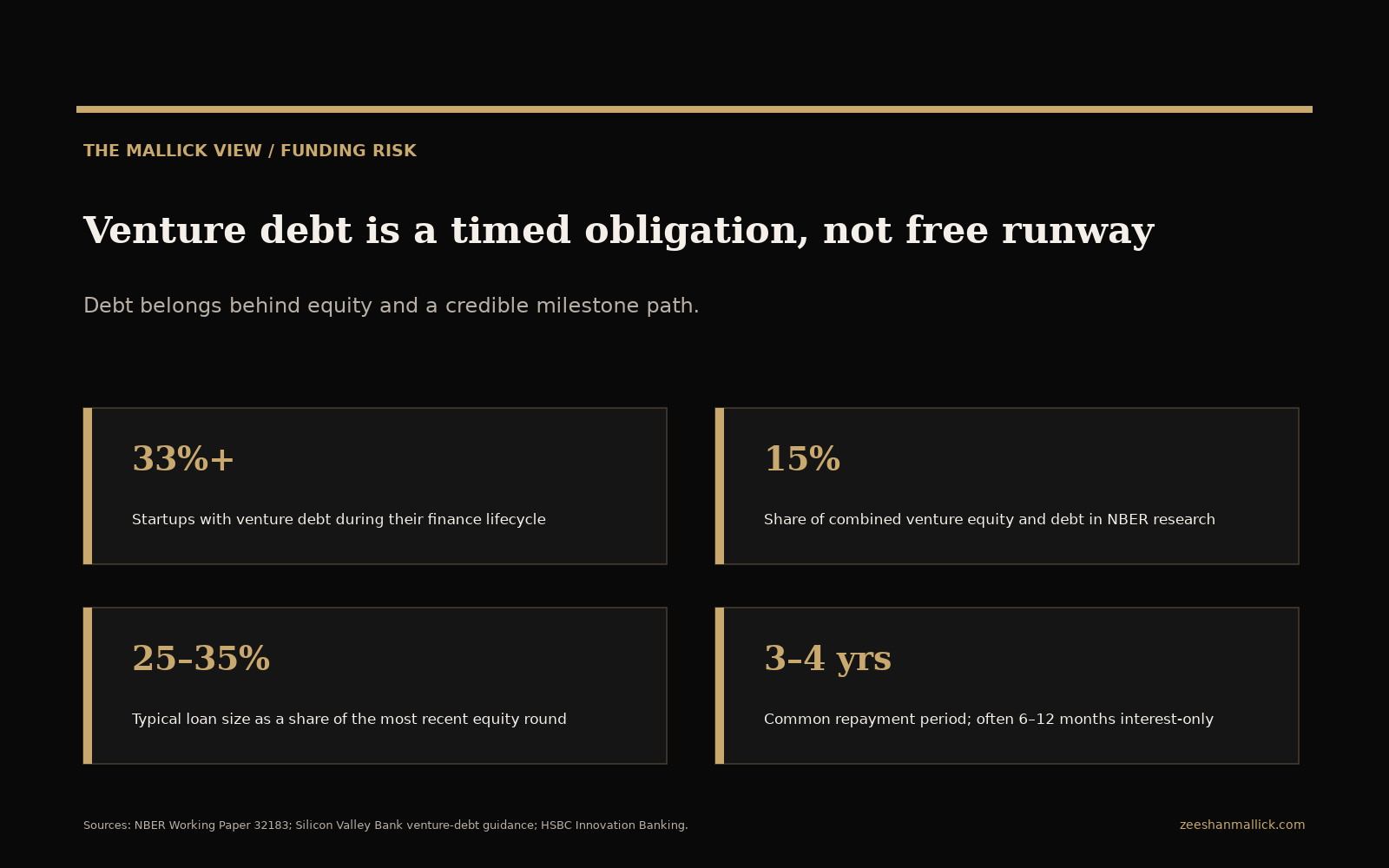
The evidence basis is limited but clear. The NBER Working Paper 32183 documents that venture debt appears in more than one-third of startups during their venture-finance lifecycles and that, in the paper's cited research base, venture debt accounts for 15% of combined venture equity and venture debt. The same paper reports that, in the cited evidence base for 2002–2022 issuance, venture-debt pricing showed a four-to-eight-percentage-point spread above prime. Read the paper here: https://www.nber.org/system/files/working_papers/w32183/w32183.pdf
Operational descriptions from specialized lenders align with the NBER findings. SVB notes that venture debt generally follows equity rather than replaces it, reports loan sizes around 25%–35% of the most recent equity round, and describes three-to-four-year repayment with a six-to-twelve-month interest-only period for many term loans. See SVB's primer: https://www.svb.com/startup-insights/venture-debt/how-does-venture-debt-work/
HSBC Innovation Banking describes common repayment profiles as 34–48 months and highlights material risks that include cash-flow constraints, missed milestones, and compliance with milestones — the very factors that convert a timing shortfall into a covenant or default risk. See HSBC's risk overview: https://www.hsbcinnovationbanking.com/us/en/resources/venture-debt-risks
Together these sources show a consistent pattern: venture debt is widespread, priced with a meaningful spread above prime in historical issuance data, sized as a portion of the last equity round, and typically repaid over several years with initial interest-only periods. These features make two practical implications unavoidable:
-
If the next equity round is the lender's expected repayment source, the borrower must plan to reach that round before repayments or covenant tests escalate. The NBER paper explicitly explains that venture debt often relies on the next financing round as a repayment source. See the NBER text: https://www.nber.org/system/files/working_papers/w32183/w32183.pdf
-
The multi-year repayment and interest-only features reduce early cash strain but create calendared obligations and covenant checks. SVB describes three-to-four-year repayment and six-to-twelve-month interest-only periods; HSBC reports 34–48 months repayment windows. See SVB and HSBC: https://www.svb.com/startup-insights/venture-debt/how-does-venture-debt-work/ and https://www.hsbcinnovationbanking.com/us/en/resources/venture-debt-risks
Decision-makers must therefore evaluate venture debt on two axes: plausibility of reaching a fundable milestone before repayment pressure, and covenant exposure if milestones slip. Treating debt as a last-resort rescue — rather than as a time‑bounded complement to a clear plan — turns a solvency problem into a covenanted countdown.
Table: concise operational comparison
| Feature | Debt-as-complement | Debt-as-rescue |
|---|---|---|
| Expected repayment source | Next equity or cash from milestones | Reliance on uncertain future financing |
| Typical sizing (reported) | Around 25%–35% of last equity round (SVB) | Same, but increases dependency on next round |
| Repayment window (reported) | Three-to-four-year / 34–48 months (SVB, HSBC) | Same, but binds sooner if milestones slip |
The evidence, briefly explained
-
Prevalence and share: The NBER Working Paper 32183 reports venture debt is evident in more than one-third of startups' venture-finance lifecycles and accounts for 15% of combined venture equity and venture debt in the cited research base. That magnitude makes venture debt material to financing strategy in aggregate. Source: https://www.nber.org/system/files/working_papers/w32183/w32183.pdf
-
Pricing: The NBER evidence base for 2002–2022 issuance reports a four-to-eight-percentage-point spread above prime for venture-debt issuance. That spread is part of the effective cost of the debt and matters when comparing debt servicing to gross margins and cash runway. Source: https://www.nber.org/system/files/working_papers/w32183/w32183.pdf
-
Structure and timing: SVB documents that venture debt frequently follows equity, loan sizes can range around 25%–35% of the most recent equity round, and many term loans feature three-to-four-year repayment with a six-to-twelve-month interest-only period. Those features create a timed repayment sequence tied to growth. Source: https://www.svb.com/startup-insights/venture-debt/how-does-venture-debt-work/
-
Risks and covenants: HSBC Innovation Banking notes common repayment windows of 34–48 months and identifies cash-flow constraints, missed milestones, and compliance with milestones as material risks. Those are the exact failure modes that change a funding gap into a covenant-triggered crisis. Source: https://www.hsbcinnovationbanking.com/us/en/resources/venture-debt-risks
What founders should measure next
Operational checklist (concrete, operator-focused):
- Absolute calendar to repayment: list the loan's scheduled amortization dates and the end of any interest-only period. (Use the term schedule from the lender.)
- Milestone calendar vs. repayment calendar: map product, revenue, and fundraising milestones against the repayment timeline. Identify the exact month the first principal payment is due.
- Dependency ratio: calculate debt size as a percentage of the most recent equity round (compare to the reported 25%–35% range).
- Next-financing probability window: estimate the earliest realistic month to close the next qualified equity round and the plan B if it misses that window.
- Covenant stress-test: itemize all loan covenants and model a 10%–30% negative deviation on top-line and cash burn assumptions to see covenant triggers. (This is a scenario exercise, not a claim about typical moves.)
- Cash-flow cushion: compute months of cash remaining after meeting scheduled interest and principal under the base and downside scenarios.
- Communication plan: prepare a covenant-mitigation narrative and data-pack for lenders and key investors (timelines, deliverables, and contingency levers).
Frequently asked questions
Q1: Is venture debt cheaper than equity?
A1: Direct price comparisons depend on context. The NBER evidence shows a four-to-eight-percentage-point spread above prime for 2002–2022 issuance in the cited base, which is one component of cost. Equity cost is dilution rather than an interest spread. The choice requires comparing expected cash servicing burden and dilution outcomes under realistic scenarios. Source: https://www.nber.org/system/files/working_papers/w32183/w32183.pdf
Q2: Will venture debt replace equity?
A2: SVB explains that venture debt follows equity rather than replaces it; lenders typically expect a preceding equity round and often expect repayment from the next round or cash flow. Using debt as a substitute for raising required equity increases risk. Source: https://www.svb.com/startup-insights/venture-debt/how-does-venture-debt-work/
Q3: What are the main risks to watch?
A3: HSBC identifies material risks including cash-flow constraints, missed milestones, and compliance with milestones. These risks create timing pressure and can trigger covenant breaches if the borrower cannot meet scheduled obligations. Source: https://www.hsbcinnovationbanking.com/us/en/resources/venture-debt-risks
Sources
- https://www.nber.org/system/files/working_papers/w32183/w32183.pdf
- https://www.svb.com/startup-insights/venture-debt/how-does-venture-debt-work/
- https://www.hsbcinnovationbanking.com/us/en/resources/venture-debt-risks
- https://www.youtube.com/watch?v=OULfZXkFvsI
Continue the conversation
Master Collective Newsletter
Receive concise perspectives on founders, capital and strategic growth.