Your 20% Option Pool Is Not a Hiring Plan. It Is a Founder Pay Cut.
A large pre-money option pool can cut founder ownership before one employee is hired. Zee argues that founders should price a real hiring plan, not accept a standard percentage.

The direct answer
Zee’s view is blunt: a 20% option pool is not proof that a startup has a serious hiring plan. It is a reserve of equity. When an investor asks for that reserve to be counted before the new money enters, the reserve can dilute founders and other existing holders before a single new hire receives a share. A founder should not reject employee ownership. A founder should reject lazy math.
The fair question is not, “What pool is standard?” The fair question is, “Which people must be hired before the next round, what grants will they need, and why should the existing cap table pay for an uncosted reserve?”
Key takeaways
- A pre-money option-pool increase can change the price per share and place dilution on existing holders rather than new investors.
- A headline valuation does not show the full ownership result. Pool size must be read beside valuation, cash raised, and investor ownership.
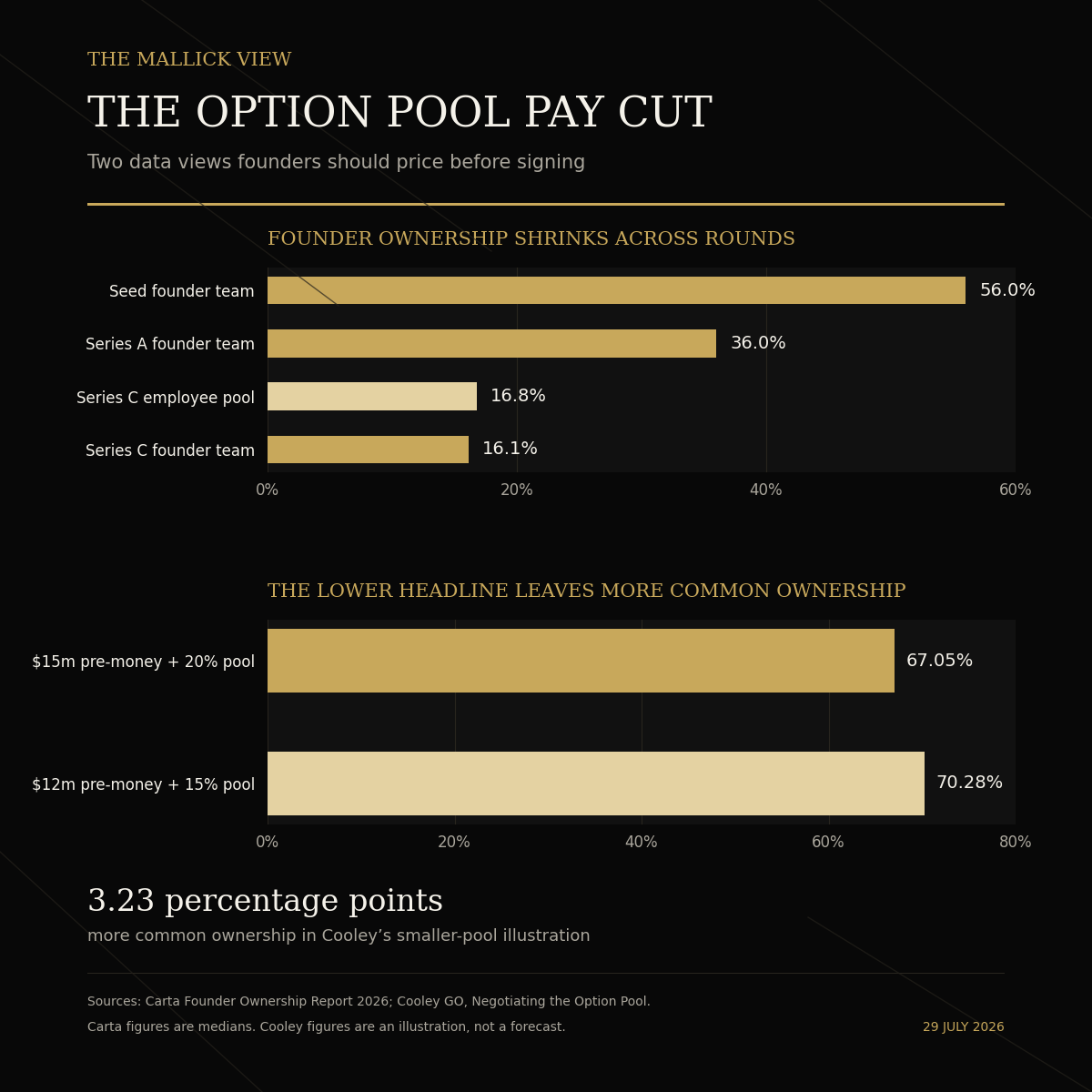
- Carta reports that the median founding team retained 56% at seed and 36% at Series A in rounds raised from 2021 through 2025.
- The right pool is a time-bound hiring budget through the next raise, not a generic 15% or 20% label.
The pool changes the price, not only the hiring plan
An option pool is a block of shares reserved for people who will provide services to the company. It can support employees, advisers, consultants, and contractors. It is a useful tool. Carta explains that the pool affects share price, ownership dilution, and company value.
The hard part is timing. In a standard venture term sheet, an investor can ask for a pool that equals a stated percentage after closing. Yet the pool can be counted in the company’s capitalization before the investor’s price per share is calculated. Cooley’s term-sheet guide says this often dilutes existing holders, not the new investor shares. That is why an empty pool can still cost founders real ownership.
This is not a claim that investors are doing something secret. The mechanism is visible in the cap table and can be negotiated. NVCA’s model legal documents are industry starting points, not a command to accept every default. A founder’s job is to model the result before signing.
A lower valuation can leave founders with more
Cooley gives a simple illustration. In both cases below, a company has 10 million common shares, 1 million outstanding options, 1 million available-pool shares, and receives $1 million of new cash. The cases differ in valuation and pool size. The important result is not the headline valuation. It is the ownership left with common holders.
| Term | Case A | Case B |
|---|---|---|
| Pre-money valuation | $15 million | $12 million |
| Post-money option pool | 20% | 15% |
| Common-stock ownership after closing | 67.05% | 70.28% |
| Difference for common holders | 3.23 percentage points in favour of the smaller-pool case | |
The example does not predict any founder’s deal. Cooley says deal math varies. It does prove the principle: a $15 million headline can be worse than a $12 million headline when the extra valuation is paired with a much larger pre-money reserve. The pool is part of the price.
Employee ownership is real. Careless reserve is not.
Employee equity matters. It helps a young company pay for skill, risk, and commitment when cash is tight. The case against a generic pool is not a case against employee ownership. It is a case for matching equity to the actual hiring plan.
Carta says early-stage companies often take 18 months to 2.5 years to move between rounds. That is the real planning window. A founder can list the roles needed in that window, assign each role a grant range, include refresh grants, and add only a measured buffer. Carta describes 10% as a common rule of thumb, but says a bottom-up plan should come first.
The ownership stakes make this worth doing. Carta’s 2026 Founder Ownership Report, based on rounds raised from 2021 through 2025, says the median founding team retained 56% of fully diluted equity at seed and 36% at Series A. At seed, the median employee pool was 12.1%. At Series C, the median employee pool was 16.8%, slightly above median founder ownership of 16.1%.
| Question | Useful answer | Weak answer |
|---|---|---|
| What is the pool for? | Named roles and refresh grants before the next round | “It is standard at this stage” |
| How long must it last? | A stated runway to the next financing | “As long as possible” |
| Who bears the dilution? | Shown in pre- and post-money cap tables | Hidden behind a headline valuation |
| What is the decision rule? | Approve only what the operating plan needs | Accept a percentage without a hiring budget |
What Zee would negotiate before saying yes
Zee would ask for a cap-table model that shows the pool before and after the financing, the investor’s ownership, the founders’ ownership, and the estimated unused shares after each planned grant. He would compare the requested pool against the 12–18 month operating plan. He would then compare at least two complete packages: a higher valuation with a larger pool and a lower valuation with a smaller pool.
He would also keep the compliance work separate from the valuation negotiation. In the United States, SEC Rule 701 guidance explains that certain compensatory sales to employees, consultants, and advisers may be exempt for non-reporting companies. The SEC also says that issuing more than $10 million under Rule 701 in a 12-month period brings specific disclosure obligations. A pool is therefore an equity and compliance plan, not a number to guess at. Company counsel should review the plan and the local-law position.
Founders who want an evidence-led approach can see how Zee frames difficult ownership decisions on the Story page and how he builds companies on the Ventures page. Founders preparing a capital discussion can also book a conversation with Zee.
The rule: pay for planned hiring, not for investor comfort
The best option pool is neither tiny nor generous by instinct. It is large enough for the hiring plan and small enough to protect the cap table until the plan changes. If the company later needs more senior talent, it can revisit the reserve with new facts, a new board decision, and a new financing context.
That is the controversial point. A founder should stop celebrating a large pool as if it is free. Empty shares still have an owner. Until they are granted, their cost is often paid by the people who built the company first.
Frequently asked questions
Is a 20% option pool always bad?
No. A 20% pool can be sensible if a company has a documented need for major hires, senior executives, or frequent grants before the next financing. The problem is accepting 20% because it sounds normal, without modelling the jobs and dilution.
Does a pre-money option pool dilute the new investor?
Often, the pool is included in pre-closing capitalization when the investor’s price per share is set. Cooley explains that this can put the dilution on existing holders rather than the incoming investor. The actual answer depends on the signed term sheet and cap table.
Should founders refuse employee equity?
No. Equity can be essential for hiring and retention. The better practice is a bottom-up option budget: identify the roles, grant ranges, timing, and reserve needed until the next round.
Is this legal advice?
No. This is founder education using public sources. Equity plans, securities rules, tax, and local-law obligations require advice from qualified company counsel and cap-table professionals.
Sources
- Carta: Option Pools
- Carta: Founder Ownership Report 2026
- Cooley GO: Negotiating the Option Pool
- NVCA: Model Legal Documents
- U.S. SEC: Employee Benefit Plans — Rule 701
Research basis: public sources verified on 29 July 2026. This article is educational analysis, not legal, tax, or investment advice.
Master Collective Newsletter
Receive concise perspectives on founders, capital and strategic growth.