A Down Round Can Dilute Founders Twice
Down rounds are rarer, not gone. Zee shows how new shares cause the first dilution and anti-dilution protection can move another 7.14 points away from common holders.
The direct answer
Zee’s view is blunt: a down round can dilute founders twice. The first hit comes when the company sells new shares at a lower price. The second can come when an old investor’s anti-dilution clause changes its conversion price and gives that investor more common-equivalent shares.
This does not mean every down round has a second hit. Broad-based weighted-average protection is more common and usually less severe than a full ratchet. The point is simple: the new valuation is only half the model. The old documents decide who pays the rest.
Key takeaways
- Carta says 11.4% of venture rounds in Q1 2026 were down rounds—roughly one in nine.
- Carta says the rate peaked at 22% in 2023, so the risk is falling but not gone.
- Cooley says anti-dilution protection can magnify dilution for common holders.
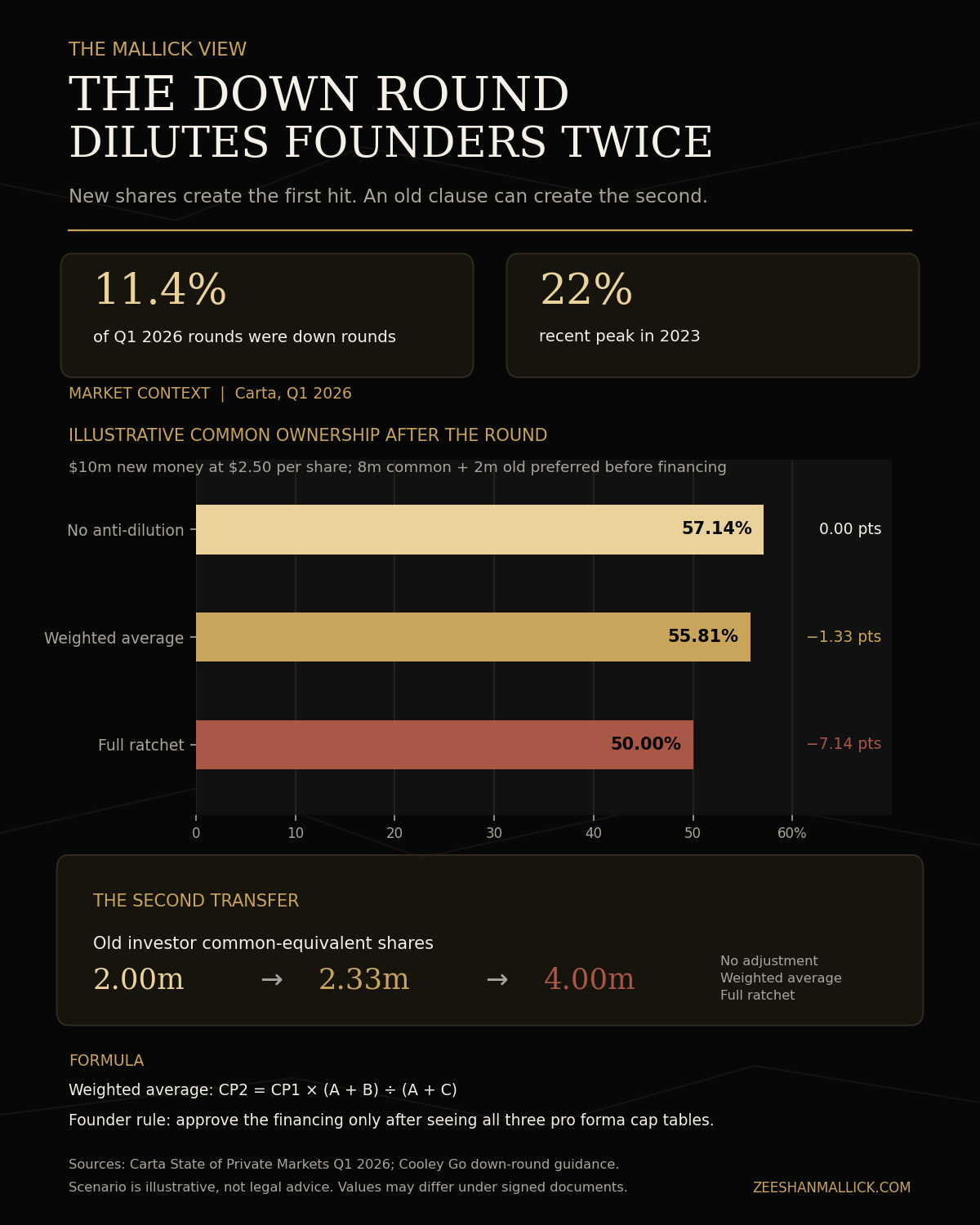
- In Zee’s transparent model, common ownership is 57.14% with no adjustment, 55.81% with weighted average, and 50% with full ratchet.
What is a down round?
Carta defines a down round as a financing whose pre-money valuation is below the prior round’s post-money valuation. The company is selling a new slice at a lower price than before.
The headline usually focuses on the valuation cut. That is incomplete. A founder must also ask how the lower share price changes the rights attached to older preferred stock.
Down rounds are rarer, not extinct
Carta’s Q1 2026 private-market report says the down-round rate fell to 11.4%, near 2019 and 2020 levels and below a 22% peak in 2023. That is good news. It is not zero. Roughly one in nine rounds still came at a lower valuation.
The same report says more than 60% of venture capital on Carta in Q1 2026 went to AI companies. It lists a median Series A valuation of about $300 million for foundational-model AI companies and $55 million for non-AI companies. Zee’s point is that founders should not use the hottest deals as their base case. The market is split.
The first dilution comes from the new shares
Consider a simple company before its new round. Founders and employees hold 8 million common shares. An old Series A investor holds 2 million preferred shares bought at $5 each. A new investor puts in $10 million at $2.50 per share and receives 4 million shares.
With no anti-dilution adjustment, the total becomes 14 million shares. Common holders own 8 million, or 57.14%. That is the first dilution.
The old clause can create a second transfer
Cooley explains that preferred anti-dilution protection can increase the number of common shares into which old preferred shares convert. The company may not issue extra preferred certificates. The economic result still moves ownership away from common holders.
| Old investor protection | Old investor common-equivalent shares | Common ownership | Extra loss versus no adjustment |
|---|---|---|---|
| No anti-dilution | 2.00m | 57.14% | 0.00 points |
| Broad-based weighted average | 2.33m | 55.81% | 1.33 points |
| Full ratchet | 4.00m | 50.00% | 7.14 points |
The broad-based weighted-average row uses Cooley’s published formula: CP2 = CP1 × (A + B) ÷ (A + C). In this model, the old $5 conversion price falls to about $4.29. The old investor’s 2 million preferred shares become about 2.33 million common-equivalent shares.
Under full ratchet, the old conversion price falls all the way from $5 to $2.50. The same $10 million original investment now converts into 4 million common-equivalent shares. Common ownership falls from 57.14% to 50%. The second transfer costs common holders another 7.14 percentage points.
Full ratchet and weighted average are not the same
Cooley says broad-based weighted average is significantly more common. It considers both the size and price of the down round. Full ratchet ignores the size of the new round and resets the old conversion price to the new low price. That is why full ratchet can be much harsher.
| Question | Broad-based weighted average | Full ratchet |
|---|---|---|
| Does round size matter? | Yes | No |
| Does the new lower price matter? | Yes | Yes |
| Typical effect | Partial adjustment | Old price resets to the new low price |
| Founder risk | Moderate second dilution | Potentially severe second dilution |
The term sheet is not the final cap table
NVCA says its model legal documents are industry starting points, not legal advice. They include alternative terms and must be tailored. A founder should not stop at the words “standard documents.” Standard language can still produce a result that is painful for the company’s actual cap table.
Cooley also notes that companies may negotiate waivers or partial reductions. Founders can ask for a cap on the adjustment, a pay-to-play condition, removal of full ratchet, or a waiver tied to the new financing. The right answer depends on leverage and the signed documents.
Zee’s founder rule
Zee’s rule is simple: no founder should approve a down round from a one-line valuation summary. The board should see three cap tables side by side: no anti-dilution, the signed formula, and the harshest enforceable case.
The founder should also see each group’s ownership before and after the round, the option-pool effect, liquidation outcomes, and voting control. A lower valuation may save the company. Hidden second dilution can still change who owns the recovery.
Readers can review Zee’s operating background on his story page and his companies under ventures. A founder who wants to test a financing waterfall before signing can book a direct conversation.
Frequently asked questions
What is a down round?
It is a financing at a lower company valuation than the previous round, usually with a lower price per share.
Why can a down round dilute founders twice?
The new shares dilute existing holders first. An old investor’s anti-dilution adjustment can then increase that investor’s common-equivalent shares.
What is full-ratchet anti-dilution?
It normally resets the old preferred conversion price to the new lower price, regardless of how small the new round is.
What is broad-based weighted-average anti-dilution?
It adjusts the old conversion price using both the new price and the size of the new issue. It is usually less severe than full ratchet.
Are down rounds common in 2026?
Carta reports that 11.4% of rounds in Q1 2026 were down rounds. That is lower than 2023 but still roughly one in nine.
What should a founder request before approval?
A full pro forma cap table, anti-dilution calculations, option-pool impact, payout waterfall, voting analysis, and qualified legal advice.
Sources and method
The market figures come from Carta’s Q1 2026 private-market report. The legal mechanics and weighted-average formula come from Cooley. The model-document context comes from NVCA. The 57.14%, 55.81%, and 50% ownership outcomes are transparent arithmetic based on the stated illustrative cap table. They are not a market forecast, legal advice, or a claim that every down round uses full-ratchet protection.
Master Collective Newsletter
Receive concise perspectives on founders, capital and strategic growth.