The $300M Mirage: Why a Bigger Valuation Can Make a Founder Poorer at Exit
Zee argues that a headline valuation is not an exit plan: founders must model the preference stack before they celebrate the price.

Direct answer
Direct answer: A larger valuation can protect a founder’s ownership today and still produce a worse outcome at exit if the price comes with a heavy preference stack, seniority or participation rights. Zee’s view is simple: before celebrating the valuation, model who gets paid first at a normal exit.
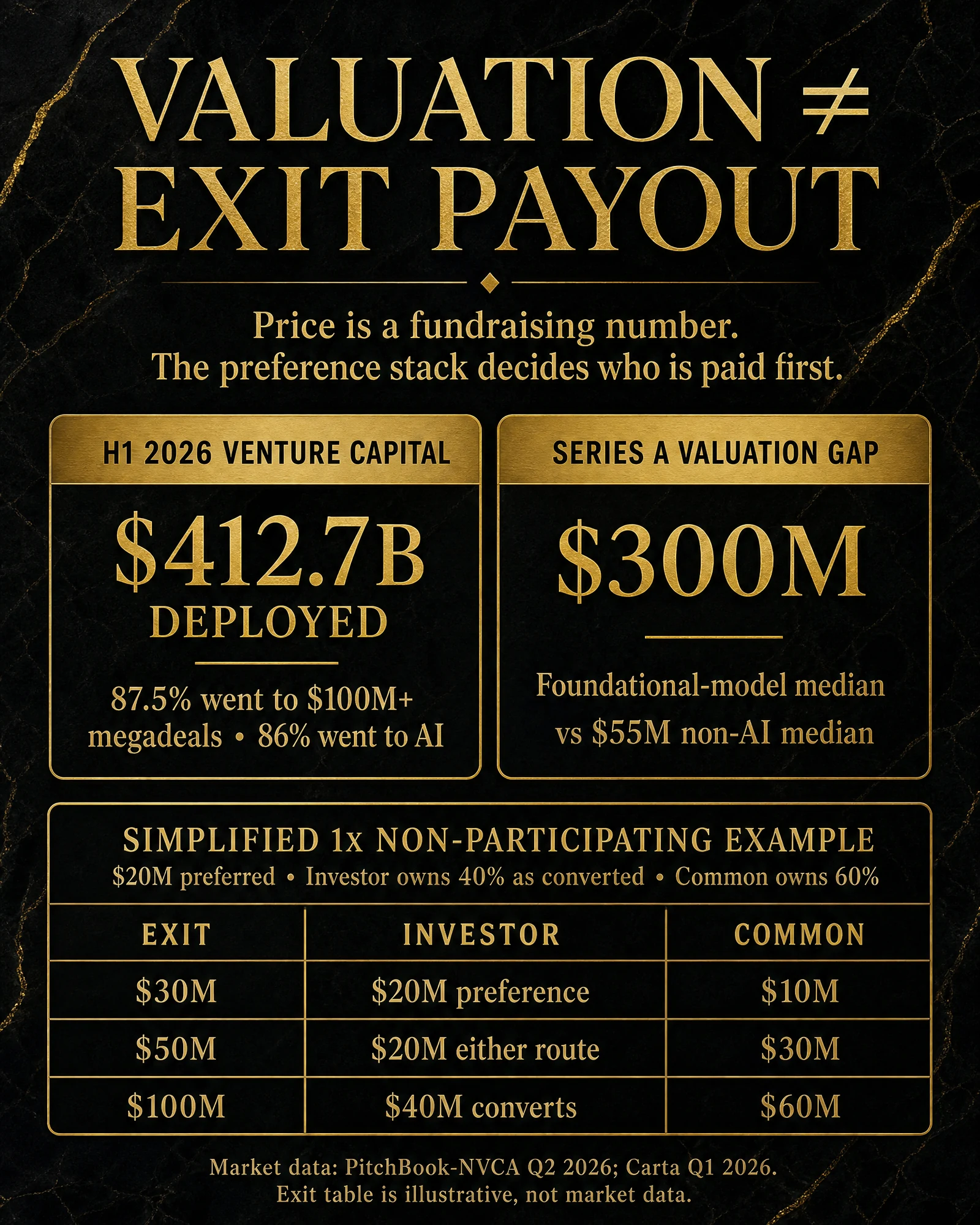
The controversial point is that founders are trained to negotiate the number at the top of the term sheet. They should spend at least as much time on the maths underneath it. In H1 2026, megadeals of $100 million or more captured 87.5% of the $412.7 billion deployed in venture capital, while AI captured 86% of venture dollars.[1] That is a striking market, but it is not a universal valuation benchmark for every founder.
Key takeaways
- A valuation is a price for a round; an exit waterfall is the contract that decides who receives cash.
- Preferred shares can be paid before common shares, and seniority, multipliers and participation can change the result.
- A clean 1x, non-participating structure can be more valuable than a higher price with aggressive downside terms.
Valuation is a number. The waterfall is a contract.
At a sale or another liquidation event, preferred holders may be paid before common holders. Carta explains that the standard preference is linked to the original issue price and that later rounds can have different seniority.[2] Morrison Foerster explains that a 1x preference generally lets a preferred holder recover its original investment before common holders, while a higher multiple or participating preference can change the outcome further.[3]
| Headline question | The better founder question | Why it changes the exit |
|---|---|---|
| What is the valuation? | What does each share class receive before common shares? | Ownership percentage does not show payout order. |
| Is the investor taking 20%? | Is the preferred stock 1x, multiple, participating or capped? | Terms can alter the investor’s downside and upside. |
| Is the round founder-friendly? | Is the stack pari passu or senior to earlier rounds? | Later money can sit ahead of earlier money and common stock. |
| Can the company raise again? | What exit value leaves common holders with a meaningful result? | The right answer depends on the whole cap table. |
A simple exit model every founder should see
Illustrative scenario, not market data: assume a company raises $20 million in preferred stock. After the round, the investor owns 40% on an as-converted basis and common holders own 60%. The preferred stock has a 1x non-participating preference. The investor can take $20 million or convert into common stock, whichever pays more.
| Exit value | Investor as preference | Investor as common | Likely investor choice | Cash left for common holders |
|---|---|---|---|---|
| $30M | $20M | $12M | Take the preference | $10M |
| $50M | $20M | $20M | Either route | $30M |
| $100M | $20M | $40M | Convert to common | $60M |
This simple example is not an argument against preferred stock. It shows why a founder should never review valuation in isolation. Add earlier rounds, a 2x multiple, a participating feature, debt, option pools or stacked seniority and the result can change sharply. NVCA describes its model legal documents as a starting point that presents options and commentary, not a substitute for tailoring a deal to the facts.[4]
Why the $300M headline can be a trap
Carta recorded $30.4 billion of startup funding in Q1 2026. More than 60% went to AI companies, and Carta reported a $300 million median Series A valuation for foundational-model companies compared with $55 million for non-AI companies at the same stage.[5] Some companies deserve exceptional pricing. The mistake is treating an exceptional market as a normal one.
A higher valuation is not automatically bad. A higher price with clean terms can be a good result. Zee’s warning is narrower: the price becomes dangerous when the founder stops asking what must happen before the next investor, buyer or public market will support it. SVB reports that only 12% of disclosed 2025 VC-backed M&A deals had known sale prices above the capital the companies had raised.[6] That makes the ordinary exit case worth modelling, not just the breakout case.
Zee’s pre-signing checklist
Zee would ask for a fully diluted cap table and a waterfall model at several exit values before signing. The discussion should cover the original issue price, preference multiple, participation, dividends, conversion rights, seniority, option-pool treatment and any debt that is paid before equity. A founder should also ask which exit range the investor thinks is realistic, not only which valuation looks impressive today.
| Term to inspect | Question to ask | Simple purpose |
|---|---|---|
| Preference multiple | Is it 1x or more? | Shows the investor’s minimum claim before common holders. |
| Participation | Does the investor receive the preference and then share again? | Tests whether the investor has both downside protection and extra upside. |
| Seniority | Which series gets paid first? | Shows whether later capital sits ahead of earlier capital. |
| Conversion | When would the investor convert to common? | Shows the exit point at which the investor changes route. |
| Exit ranges | Can counsel model low, base and high exits? | Turns a term sheet into understandable outcomes. |
This is not legal, tax or investment advice. It is a founder discipline. A strong investor should be comfortable explaining the economics, and qualified legal counsel should review the documents. A founder who understands the waterfall is harder to pressure with a flattering price.
Frequently asked questions
What is a liquidation preference?
It is a contractual right that can allow preferred holders to receive sale proceeds before common holders. The exact result depends on the deal documents, seniority and conversion choices.
Is a 1x preference always bad for founders?
No. A 1x non-participating preference is often a standard form of downside protection. The key is to understand it alongside the full stack, valuation and exit range.
Does a higher valuation always make a founder poorer at exit?
No. A higher valuation can be beneficial when the terms are clean and the business can support the next financing or exit. The risk rises when price distracts from aggressive economic rights or unrealistic expectations.
What should a founder request before accepting a term sheet?
Request a fully diluted cap table and waterfall model at several exit values, then review the terms with qualified counsel and the company’s finance lead.
Why model a modest exit?
Because most decisions should be tested against more than one outcome. A modest exit model shows whether common holders retain a meaningful result if the company does well without becoming an outlier.
References
Master Collective Newsletter
Receive concise perspectives on founders, capital and strategic growth.