Angel Portfolios Need a Follow-On Rule Before the First Deal
Angel investors should set a portfolio system before saying yes. Define breadth, check size, follow-on reserves, diligence depth, and review rules so follow-ons are decisions from a plan, not gut reactions.

Decision: Angel investors should create a clear portfolio system, including a rule for follow-on reserves, before they make their first check. That system should set breadth, check size, domain focus, diligence depth, follow-on reserves, decision rights, and regular review rules so follow-on choices are governed by a plan rather than emotion.
- Set a written follow-on reserve rule before any investment.
- Define portfolio breadth, check-size bands and domain focus up front.
- Choose due-diligence depth and decision rights proportionate to expected ownership.
- Review the system regularly and record deviations from the rule.
Why make a follow-on rule first?
When an investor waits to set follow-on policy until after a hot deal, choices are often emotional and ownership can erode. A pre-defined rule anchors capital allocation, helps preserve ownership when winners emerge, and reduces the chance of over-committing to late-stage decision pressure. AngelList explains that portfolio construction should decide fund size, number of investments, check size or target ownership, follow-on strategy, and capital recycling — a pre-determined plan can guide follow-on decisions by balancing ownership preservation against opportunity cost. See AngelList for this guidance: https://www.angellist.com/learn/portfolio-construction.
Evidence that structure matters
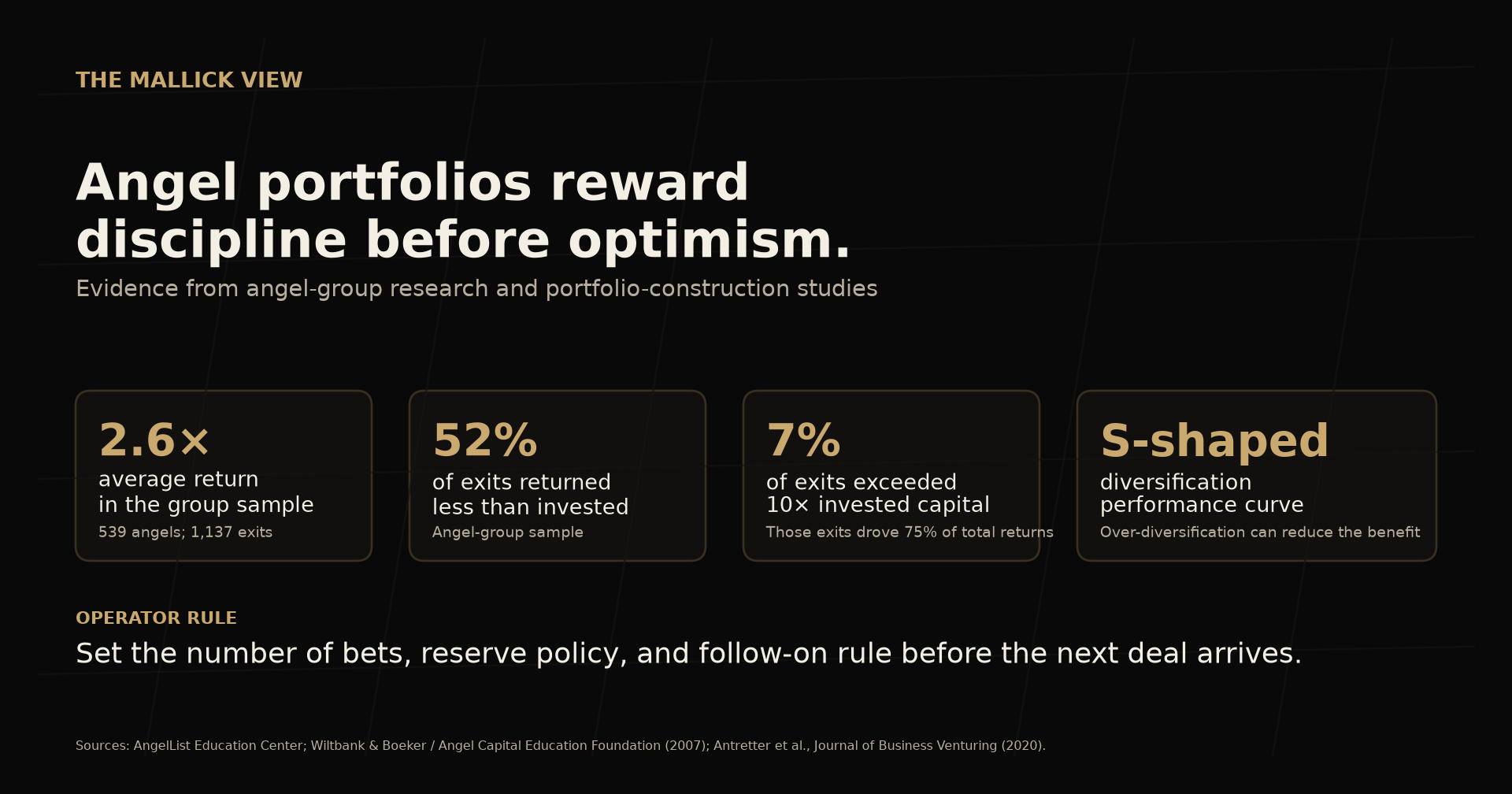
Group-based angel data show outcomes concentrate heavily in a few big wins: a study of 539 angel investors and 1,137 exits reported an average return of 2.6x over 3.5 years; 52% of exits returned less than invested capital; 7% of exits exceeded 10x and those 7% accounted for 75% of total investment-dollar returns — see the Angel Capital Education Foundation study for the figures cited here: https://www.angelcapitalassociation.org/data/Documents/Resources/AngelGroupResarch/1d%20-%20Resources%20-%20Research/6%20RSCH_-_ACEF_-_Returns_to_Angel_Investor_in_Groups.pdf.
Research on diversification and platform co-investment shows a nuanced effect: a study of 142 professional angel-platform members from 2013–2017 found an S-shaped relationship between industry diversification and performance — diversification helps up to a point, but over-diversification can hurt; knowledge of the co-investment network moderates that downside. See Antretter et al.: https://www.sciencedirect.com/science/article/pii/S088390261830781X.
How to design a practical portfolio system
Design the system around these elements: breadth (how many positions), check-size policy (bands or percent ownership targets), domain focus (which sectors you will and will not invest in), due-diligence depth for small versus large checks, explicit follow-on reserve rules, decision rights (who decides to follow on), and scheduled portfolio reviews. The Inter-American Development Bank venture-capital toolkit recommends an explicit thesis, risk-management framework, governance, investment memos, committee approval, due diligence, portfolio reporting, and performance evaluation — all helpful operational pieces: https://publications.iadb.org/publications/english/document/Venture-Capital-Fund-Toolkit-A-guide-to-set-up-a-VC-fund-in-Latin-America-and-the-Caribbean.pdf.
| Feature | Reactive deal-by-deal | Pre-set portfolio rule |
|---|---|---|
| Follow-on decision | Emotional, ad hoc | Planned by reserve percentages and ownership targets |
| Ownership preservation | Often declines | Protected by pre-allocated reserves |
| Diligence variance | Inconsistent | Matched to check-size bands |
Practical operator checklist
- Write a short portfolio policy document before the first check.
- Set portfolio breadth (target number of positions) and expected hold period.
- Create check-size bands and corresponding diligence requirements.
- Reserve follow-on capital as a percentage of dry powder or initial commitment.
- Define decision rights and escalation for larger follow-ons.
- Schedule quarterly portfolio reviews and record rule deviations.
- Document learning and update the policy annually.
Won’t a rule stop opportunistic wins?
No — a rule is a guide, not a ban. The rule can include an exceptions process with committee approval so genuine opportunities are captured while bias and panic-buying are reduced.
How does this fit with syndicates and co-investment?
Co-investment networks change available follow-on capital and information. Empirical work shows that knowledge of your co-investor network moderates diversification effects, so explicitly model co-investment when sizing reserves. See Antretter et al.: https://www.sciencedirect.com/science/article/pii/S088390261830781X.
Does past angel-group performance predict future returns?
Historical results are informative but not predictive. The ACEF angel-group sample shows concentrated returns and many down exits; that is historical evidence and not a forecast. See the ACEF study: https://www.angelcapitalassociation.org/data/Documents/Resources/AngelGroupResarch/1d%20-%20Resources%20-%20Research/6%20RSCH_-_ACEF_-_Returns_to_Angel_Investor_in_Groups.pdf. This article is an editorial operating framework, not investment advice.
Sources
AngelList on portfolio construction: https://www.angellist.com/learn/portfolio-construction
ACEF angel-group returns study: https://www.angelcapitalassociation.org/data/Documents/Resources/AngelGroupResarch/1d%20-%20Resources%20-%20Research/6%20RSCH_-_ACEF_-_Returns_to_Angel_Investor_in_Groups.pdf
Antretter et al., Journal of Business Venturing: https://www.sciencedirect.com/science/article/pii/S088390261830781X
Inter-American Development Bank VC toolkit: https://publications.iadb.org/publications/english/document/Venture-Capital-Fund-Toolkit-A-guide-to-set-up-a-VC-fund-in-Latin-America-and-the-Caribbean.pdf
Homepage · Story · Ventures · Book Me
Related Mallick View: fundraising-unit-economics-2026 working-capital-payment-terms-2026 board-information-asymmetry-2026
Note: historical evidence cited above is not a forecast. This is an editorial operating framework and not investment, legal, tax, or accounting advice.
Master Collective Newsletter
Receive concise perspectives on founders, capital and strategic growth.