Your Board Pack Is Not Governance. It Is an Information-Asymmetry Test.
A polished board pack can look like governance. It often isn’t. Good governance forces the board and founder to surface constraints, options, evidence gaps, and the assumptions that would change the decision.

This is not investment, legal, accounting, or tax advice. The Mallick View presents an evidence-led guide for leaders and boards to treat board packs as an information-asymmetry test rather than a governance substitute.
The decision
Boards must decide whether a founder’s board pack reduces information asymmetry enough to support a high-quality decision. The short decision: accept a narrative only when the pack openly lists the decision-relevant constraints, available options, key evidence gaps, and the assumptions that would change the answer.
Why this matters: a founder’s polished narrative can be persuasive without being complete. Boards that treat a pack as a governance product risk approving choices that are under-specified or dependent on hidden assumptions. Instead, a board should use the pack as a diagnostic: what does the board still not know, what can it test, and which assumptions should be stress-tested?
The evidence
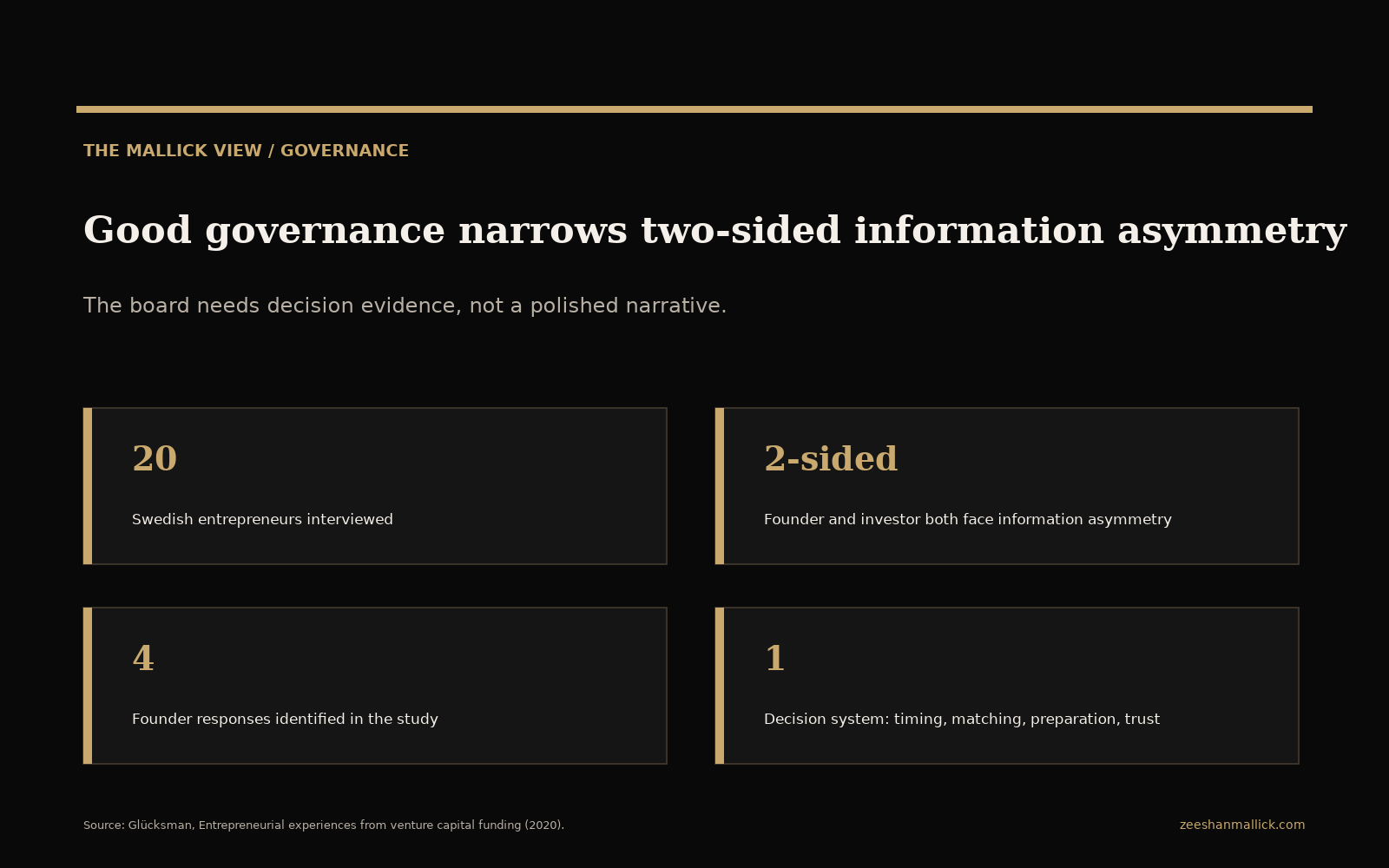
A focused empirical study from Chalmers University examined the information asymmetry in venture-capital relationships by interviewing 20 Swedish entrepreneurs. The study describes asymmetry as two-sided: founders typically know the venture intimately but are often less familiar with VC processes and requirements. The paper identifies four mechanisms founders use to mitigate the asymmetry: timing the raise, matching the VC to the startup, preparing for the process, and building an open, trusting relationship. The paper also explains that investors use screening, due diligence, syndication, staging, contracting, and monitoring, while founders must also assess the investor’s fit, incentives, and actual contribution. See the full study here: https://research.chalmers.se/publication/519627/file/519627_Fulltext.pdf
This study provides an evidence anchor for two linked claims the board must test:
- Founders hold deep domain knowledge about product, customers, and operations. That knowledge is necessary but not sufficient for governance.
- Investors and boards use formal processes (screening, due diligence, syndication, staging, contracting, monitoring) that surface different types of information than a founder’s narrative.
Reasoning (explicit): if governance is supposed to reduce bad decisions caused by missing or asymmetric information, then the board pack should be measured against how well it exposes the missing pieces. A packed slide deck that hides uncertainty or hides alternative options increases the risk of decisions being based on unstated premises.
Decision framework (concise): evaluate any board pack by four checks:
- Constraints: Does the pack list binding constraints (cash runway, regulatory milestones, contractual limits)?
- Options: Are alternative actions and their trade-offs presented and quantified where possible?
- Evidence gaps: Which critical assumptions lack direct evidence and how do they change the decision if false? (Label these explicitly.)
- Metrics and triggers: What measures and decision triggers convert uncertainty into staged choices?
Operational implications: use the pack not as the end of governance but as the beginning of targeted governance. The board’s job is to convert narrative into tests, staging, and monitoring protocols. That requires the founder to surface what they know, what they do not know, and what evidence would change their mind.
| Quick comparison | Board pack (common) | Governance as an information test |
|---|---|---|
| Primary purpose | Communicate progress and persuade | Surface asymmetry and enable staged decisions |
| Typical content | Polished narrative, KPIs, milestones | Constraints, options, explicit evidence gaps, decision triggers |
| Main risk | Hiding uncertainty; persuading without testing | Failing to close evidence gaps before a decision |
What founders should measure next
An operator checklist for founders to turn a pack into a governance-ready document:
- List the top 3 binding constraints (e.g., runway in months, regulatory blockers, key-contract dependencies). Be numerical and current.
- For the board decision being requested, list the explicit alternatives (minimum 2) and the primary trade-offs for each.
- Identify the 3 most important assumptions that would change the decision if they were false. For each, state the evidence you already have and the evidence you still need.
- Propose a staged plan that ties incremental funding or approvals to evidence milestones and measurable triggers.
- Include a short monitoring plan: who tracks each trigger, what data source, and the review cadence.
- For each investor or board member, include one clear ask about their expected contribution, how it will be measured, and a short conflict-of-interest note.
These are operational checks that convert persuasion into testable commitments.
The evidence above is anchored to the Chalmers University study of 20 Swedish entrepreneurs and the mechanisms it documents. See the study here again: https://research.chalmers.se/publication/519627/file/519627_Fulltext.pdf
Frequently asked questions
Q: If the founder’s pack looks great, why ask for more?
A: A polished pack can hide key assumptions. Governance requires the board to know which assumptions matter and how to test them. The pack must name those assumptions.
Q: Can the board rely on verbal updates instead of tests?
A: Verbal updates help but are more prone to optimism bias and selective memory. Tests, staged choices, and monitoring convert words into operational signals that persist beyond a meeting.
Q: Should founders fear that listing gaps reduces confidence?
A: No. Listing gaps signals realism and enables the board to support high-quality choices. It reduces the risk of later surprises.
Sources
Continue the conversation
- Home
- Book Zeeshan
- Related: Your investors' board seat is not advice
- Related: The famous angel is not your strategy
- Related: CEO calendar: growth tax 2026
Master Collective Newsletter
Receive concise perspectives on founders, capital and strategic growth.