The Famous Angel Is Not Your Strategy: Why Follow-On Capacity Beats Reputation
Zee argues that founders should test an investor’s reserves, decision process and customer access before taking a famous name onto the cap table.

Direct answer
Direct answer: A famous angel can open doors, but reputation is not a funding strategy. Zee’s view is that a founder should judge an early investor by the next proof point: whether the investor has useful reserves, a clear decision process, relevant customer access and the courage to give an honest answer.
The controversial idea is simple: founders spend too much time asking who will post about the round and too little time asking who can help when cash is low. A recognisable name can make a pitch deck look stronger. It cannot guarantee a bridge, a customer introduction or a quick follow-on decision.
Key takeaways
- Reputation is not the same as follow-on capacity.
- Fund size matters less than remaining reserves, fund age and the investor’s decision process.
- Founders should diligence an investor as carefully as an investor diligences a founder.
Why this matters now
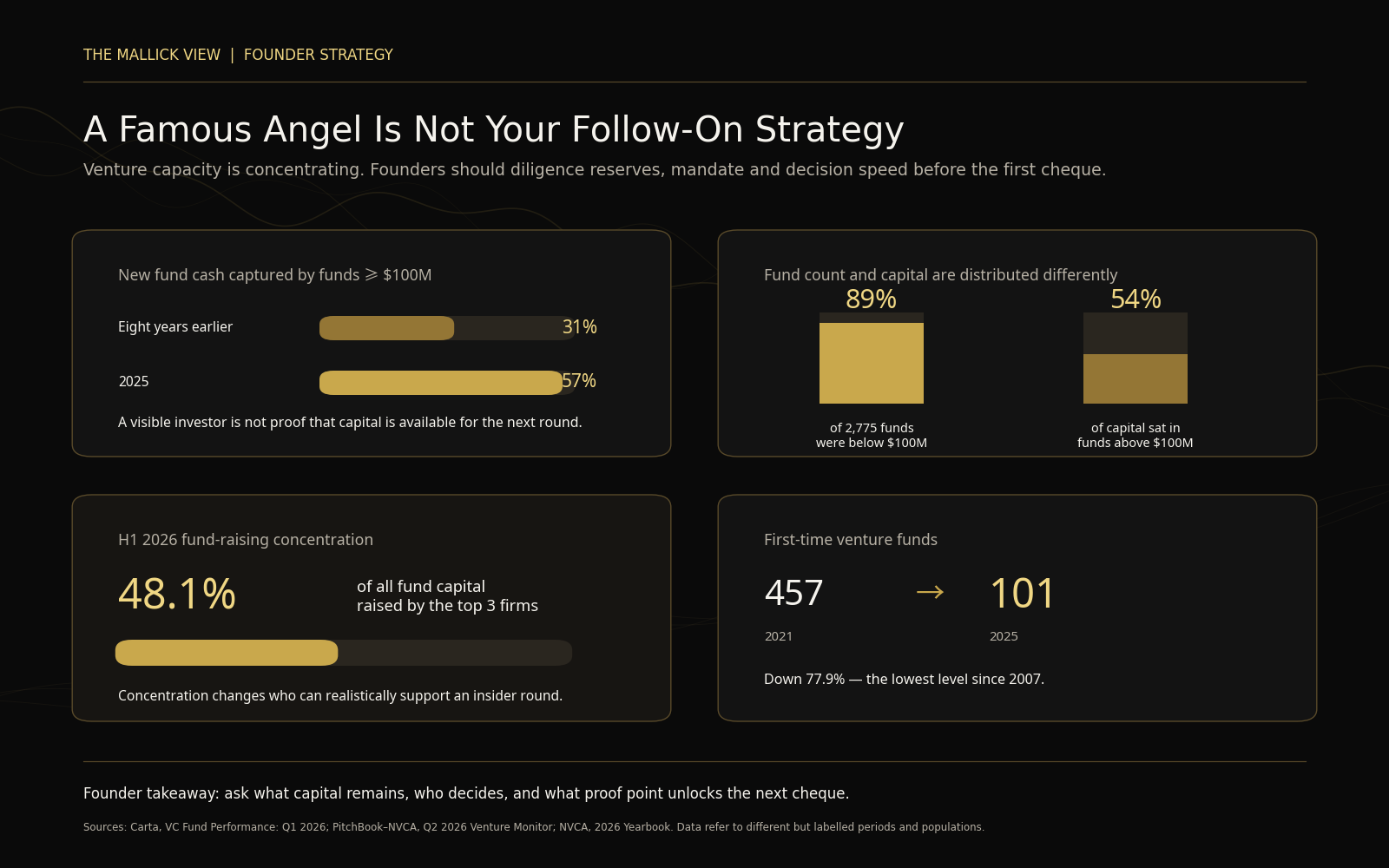
Venture capital is becoming more concentrated. Carta reports that 57% of cash raised by new venture funds in 2025 went to vehicles with at least $100 million in commitments, up from 31% eight years earlier.[1] The same report covers 2,775 venture funds: about 89% were below $100 million, but funds above that size held about 54% of the capital.[1]
This is not an argument against small funds or angels. Some of the best investors are small, decisive and deeply useful. It is an argument against guessing. Carta says funds closed in Q1 2026 had deployed about 28% of committed capital, leaving about 72% as dry powder.[1] A founder needs to know how much of that dry powder is actually relevant to the company, not simply admire the headline fund size.
| Founder test | Popular question | Better question |
|---|---|---|
| Visibility | Will this investor make the round look important? | Will this investor make a useful introduction in the next 90 days? |
| Fund capacity | How large is the fund? | How much reserve capacity remains, and how is it allocated? |
| Decision speed | Do they like the company? | Who decides, what evidence is needed and how long does the decision take? |
| Follow-on support | Will they invest again? | What specific milestone would earn a follow-on cheque? |
The market is rewarding concentration, not certainty
PitchBook and NVCA reported that three firms—Andreessen Horowitz, Thrive Capital and Founders Fund—took 48.1% of all capital raised in H1 2026. The same report said first-time fund formation was on pace for its lowest level since 2016.[2] That does not make every established investor right for every founder. It does mean founders should stop treating investor diligence as a polite exercise.
NVCA’s 2026 Yearbook reports that just 101 first-time funds closed in 2025, down 77.9% from 457 in 2021.[3] A founder who needs capital in 18 months should understand whether today’s investor will have a fresh mandate, a stretched portfolio or a different priority by then.
Zee’s investor diligence checklist
Zee advises founders to ask clear questions before accepting a cheque. Which vehicle is investing: a personal angel account, a fund or an SPV? What year did the fund close? What percentage of capital is reserved for follow-ons? Who makes the decision? What evidence would trigger another investment? Which customers, operators or future investors can this person credibly introduce?
A good investor will answer without theatre. A weak answer is not always a reason to walk away. It is a reason to price the risk honestly. An angel may be brilliant for hiring, distribution or product judgment even when they cannot follow on. The founder simply should not build a financing plan that assumes the angel can do a fund’s job.
What founders should do instead
Choose investors for a defined role. One investor may bring customer access. Another may understand the market. A third may have the reserves and process to support a later round. Zee’s point is not to demand every strength from one person. It is to build a cap table on facts, not fame.
Frequently asked questions
Should a founder reject a famous angel?
No. A famous angel can be valuable. The founder should be clear about the role that person can play and should not mistake visibility for a commitment to fund the next round.
What is follow-on capacity?
Follow-on capacity is an investor’s practical ability and willingness to invest again after the first cheque. It depends on reserves, mandate, fund age, decision rights and portfolio priorities.
What is the best question to ask an early investor?
Ask which specific milestone would make the investor want to invest again, who makes that decision and how much capital is normally reserved for follow-ons.
Does a small fund make a bad investor?
No. Small investors can be excellent. The mistake is assuming a small vehicle can provide the same follow-on role as a large fund without checking.
References
Master Collective Newsletter
Receive concise perspectives on founders, capital and strategic growth.