Your Investor’s Board Seat Is Not ‘Advice’: It Is a Vote on Your Company
Zee argues that a board seat is not a relationship benefit. It is a governance right that can shape the CEO, strategy, funding and exit decisions.

Direct answer
Direct answer: a board seat is not a thank-you gift for an investor who helped with a round. It is a vote on the company. Zee’s view is blunt: a founder who gives away a board seat without modelling the next hard decision is not just raising money. The founder is selling governance.
The controversial truth is that many founders negotiate valuation like it is the whole deal, then treat a board seat as a polite extra. It is not an extra. Delaware General Corporation Law §141 says that a corporation’s business and affairs are managed by or under the direction of its board, subject to the certificate of incorporation.[1] A board seat can therefore matter when the company chooses a CEO, sets senior pay, approves a major transaction, changes strategy or decides how to fund the next chapter.
Key takeaways
- A board seat is a governance right, not a networking reward.
- Three seats can create very different decision paths, even when the ownership percentages look similar.
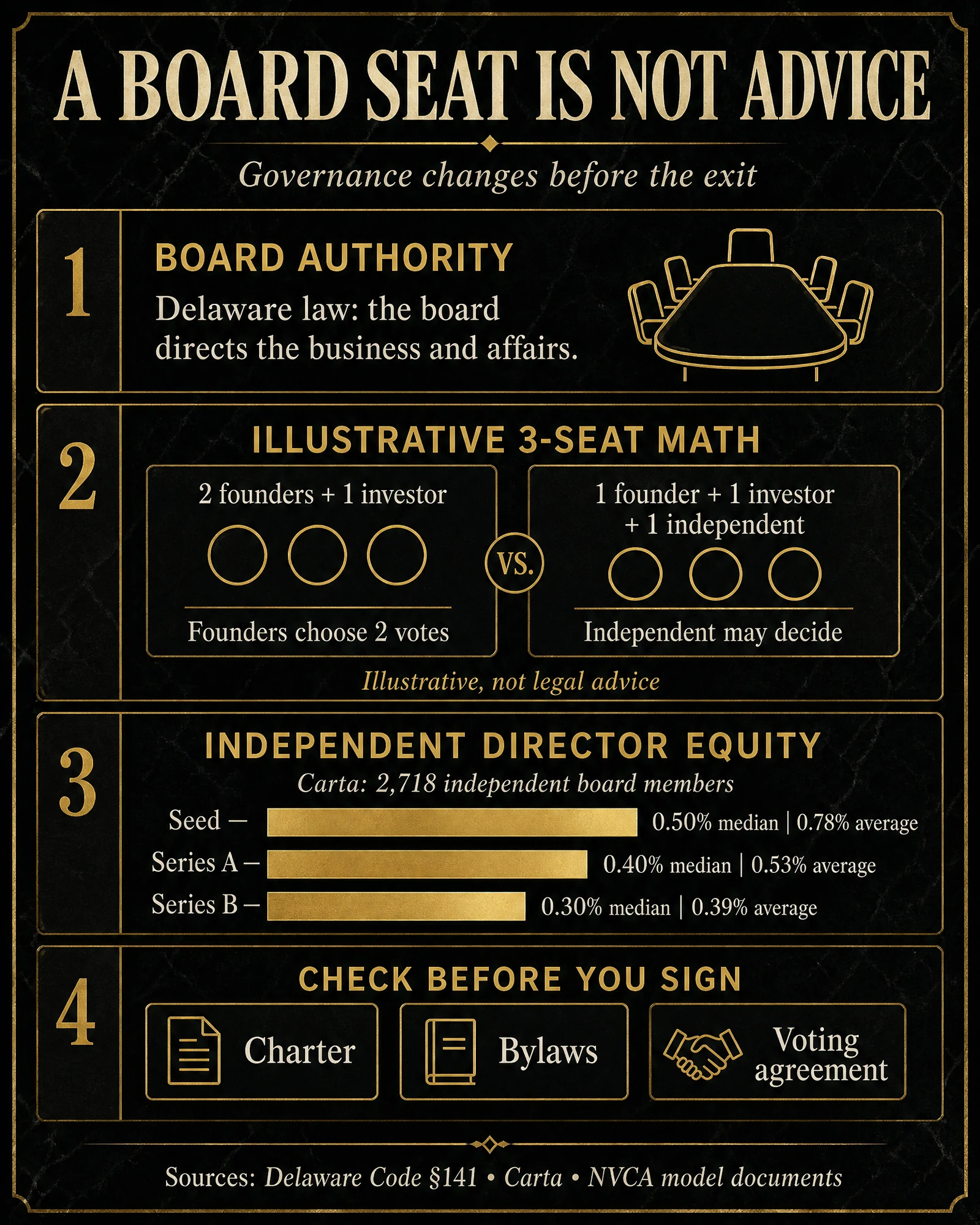
- An independent director is not free: Carta’s cited early-stage data shows median equity grants of 0.50% at seed, 0.40% at Series A and 0.30% at Series B.
- Before signing, founders should read the charter, bylaws and voting agreement together with qualified legal advisers.
Why one seat can change the company
Carta explains that each director has an equal vote and that board composition can affect the balance of founder and investor control.[2] This does not mean that an investor-nominated director is allowed to act only for that investor. Directors have duties to the company. It does mean that seat design changes who is present, who has information and how a contested decision can be decided.
The law also makes mechanics matter. Under DGCL §141(b), the number of directors is fixed by the certificate of incorporation or bylaws, and a majority of the total number generally forms a quorum unless the governing documents say otherwise.[1] That is why a founder should never discuss a board seat in isolation. The real question is: what will the board look like after the next round, the next independent appointment and the next disagreement?
| Headline question | Governance question | Why it matters |
|---|---|---|
| Does this investor add value? | Which decisions will this director vote on? | Board votes can touch CEO leadership, compensation, financing, strategy and exits. |
| Is the investor respected? | Who appoints the other seats after this round? | One seat changes the future bargaining position. |
| Is the valuation strong? | What do the charter, bylaws and voting agreement say? | Governance rights often sit outside the valuation headline. |
| Can the founder keep control? | What happens if the board disagrees? | Ownership percentage alone does not answer a board-vote question. |
The simple seat math founders should model
Illustrative board math, not legal advice: assume a three-seat board, a valid quorum and one vote per director. Carta says startups commonly use odd numbers of directors to avoid voting ties, and that each director has an equal vote.[2] The examples below are not promises about legal outcomes. Actual results depend on the certificate, bylaws, voting agreement, stockholder rights, fiduciary duties, conflicts, committees and the facts of the decision.
| Illustrative three-seat board | Simple contested vote | Founder-strategy implication |
|---|---|---|
| 2 founder-designated / 1 investor-designated | Two founder-designated directors can carry a simple 2–1 vote. | The founder group has more room, but documents and duties still matter. |
| 1 founder-designated / 1 investor-designated / 1 independent | The independent director can become decisive in a 1–1 split. | Selection of the independent seat is a major governance decision. |
| 1 founder-designated / 2 investor-designated | Two investor-designated directors can carry a simple 2–1 vote. | The founder has a weaker position in a board dispute, even if the founder owns more shares. |
The point is not that investors are villains. Strong investors can improve a board. The point is that “helpful” is not a governance structure. A founder should plan for the day when the board must make a hard choice, not only for the day everyone is celebrating a close.
The cost of an independent voice
Founders often say that an independent director will solve the balance problem. That may be right. But it is still a real decision. Carta’s cited data covers 2,718 independent board members at early-stage Carta companies. It reports median equity grants of 0.50% at seed, 0.40% at Series A and 0.30% at Series B; the most common vesting schedule was four years.[3] These are independent-director benchmarks, not a price list for investor seats and not a required market term.
| Stage in Carta’s cited independent-director dataset | Median equity grant | Founder lesson |
|---|---|---|
| Seed | 0.50% | Independence has a cost and should be planned, not added in panic. |
| Series A | 0.40% | The seat should be defined before a contested vote is needed. |
| Series B | 0.30% | Later-stage governance still requires deliberate design. |
Where the real rights may be hiding
NVCA’s model legal-document library includes a Certificate of Incorporation, Stock Purchase Agreement, Investors’ Rights Agreement, Voting Agreement and Right of First Refusal and Co-Sale Agreement.[4] NVCA calls the documents a starting point to tailor, not legal advice. That is the right mindset. A board seat cannot be understood by reading one email or one term-sheet line.
Carta lists board involvement in CEO and executive decisions, senior compensation, major transactions such as M&A and IPOs, high-level strategy and certain compliance or approval tasks.[2] Zee’s practical rule is simple: do not ask only who the investor is. Ask what this board will be able to decide when the company is under pressure.
| Before signing a board term | Ask to see | Reason |
|---|---|---|
| Seat count | Current and proposed certificate and bylaws | Shows who fixes the number of directors and how it may change. |
| Appointment rights | Voting agreement and stockholder agreements | Shows who can designate, replace or remove directors. |
| Decision rules | Quorum, vote and consent provisions | Shows whether a simple majority is enough. |
| Future scenario | A three-year board map after likely rounds | Tests the structure before the next investor changes it. |
The best investor will not fear this diligence. Clear governance protects good directors too. The bad outcome is not a board with investors. The bad outcome is a founder who discovers the real board structure only when the company is in trouble.
Frequently asked questions
Does a board seat give an investor control of the company?
Not automatically. A board seat is one governance right. Control depends on the board’s composition, voting rules, corporate documents, stockholder rights and the specific decision. Founders should obtain qualified legal advice.
Can a founder own most of the shares but lose a board vote?
Yes, ownership and a board vote are different questions. Carta notes that each director has an equal vote. The exact effect depends on the company’s documents and the matter before the board.
Should founders refuse every investor board seat?
No. An experienced investor can add real value. The founder should make the seat decision deliberately, with a clear view of who appoints the rest of the board and what rights the documents create.
Is an independent director always neutral?
An independent director should be selected for judgment and duty to the company, not as a hidden representative of one side. The selection process, incentives and documents still matter.
What should a founder do before agreeing to a board seat?
Review the charter, bylaws, voting agreement and financing documents with qualified counsel. Model the board after this round and the likely next round, including the process for choosing any independent director.
References
Master Collective Newsletter
Receive concise perspectives on founders, capital and strategic growth.