Your Fundraising Story Is Not a Business Model. Unit Economics Decide Whether Growth Compounds.
A pitch that feels persuasive is not the same as evidence that raising more capital will strengthen a business. Unit economics — per‑unit profitability and customer economics — show whether growth compounds or simply accelerates cash burn.

Decision-first opening
The Mallick View recommends a single clear action: stop treating a fundraising narrative as proof that extra capital will make a company stronger. Founders must measure unit economics at the cohort level before asking for more runway. This is not investment, legal, accounting, or tax advice — it is a decision framework to judge if growth will compound.
The decision
Unit economics decide whether growth compounds. Mercury defines unit economics as per-unit profitability and distinguishes product contribution margin from customer economics based on lifetime value (LTV), acquisition cost (CAC), and payback period. Those levers — contribution margin, LTV/CAC, and payback — are the evidence a founder must present, not only a persuasive story.
- Product contribution margin shows whether the product earns money when one unit is sold.
- Customer economics, built from LTV and CAC, show whether acquiring a customer creates long-term value for the business.
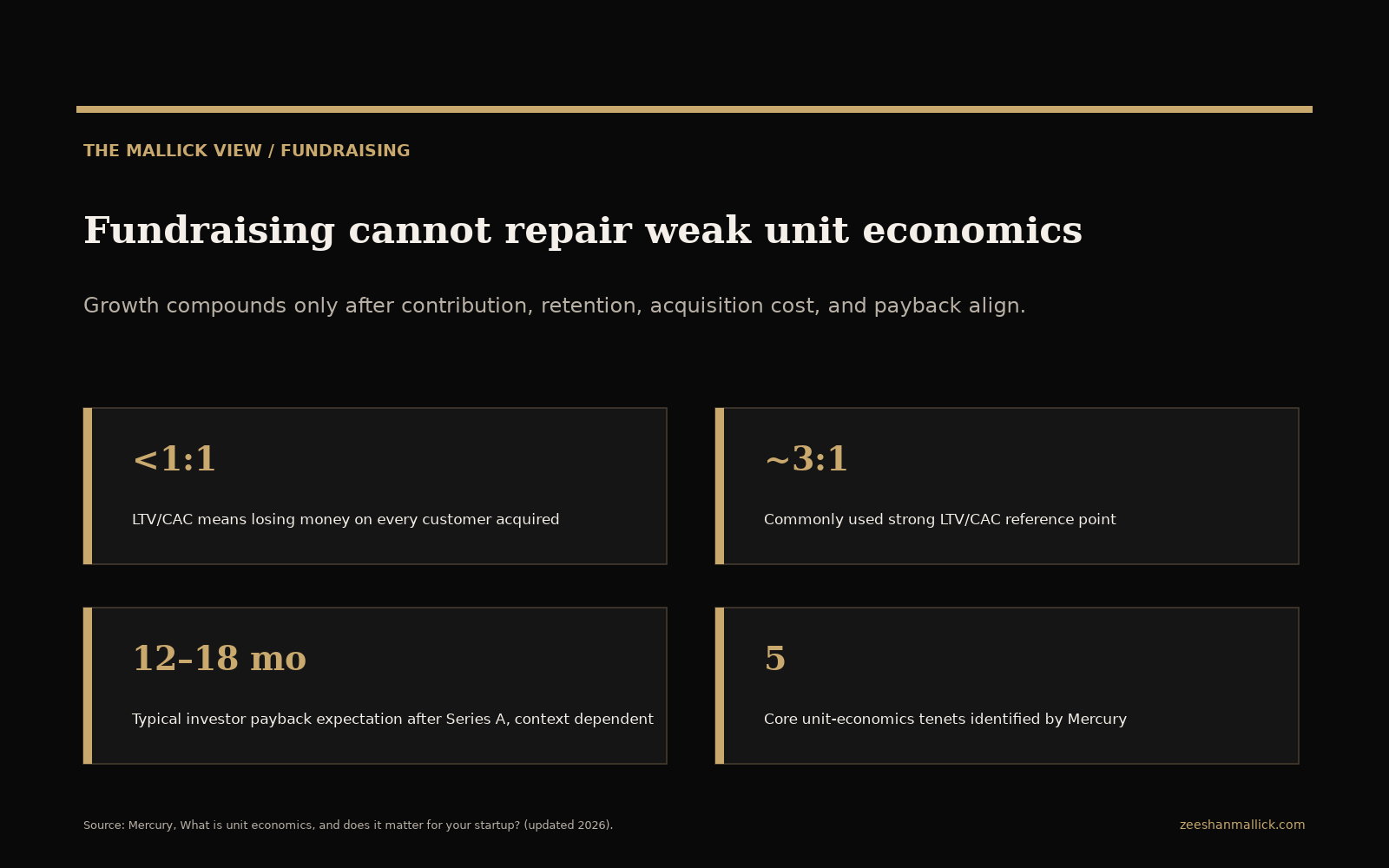
Mercury says LTV/CAC below 1 means a company loses money on every acquired customer and describes roughly 3:1 as a commonly used strong ratio, while cautioning that context matters. Mercury also notes long payback periods make growth more cash‑intensive and that later-stage investors often look for LTV/CAC at 3:1 or better alongside roughly 12–18 months or less payback, depending on the sales motion. These specific relationships are not rules; they are evidence points from a practitioner source to inform decisions: https://mercury.com/blog/understanding-unit-economics.
Evidence-led explanation
A founder launches a product, builds a pitch, and raises money. The pitch explains vision, market, and go-to-market. It can feel convincing. But persuasion does not equal evidence of scalable economics. The right evidence is cohort-level contribution margin and customer economics by acquisition channel and cohort vintage. Unit economics measured at those levels show whether additional capital will compound returns or simply speed up cash outflows.
Cohorts matter because customers behave differently depending on when and how they were acquired. Contribution margin on a product can be positive even while customer economics are negative. That happens when CAC exceeds the lifetime value of customers. Mercury’s description of unit economics separates these layers clearly: product contribution margin on one hand, and customer economics framed by LTV, CAC, and payback on the other. Use that separation to ask exact questions: Which cohort has positive contribution margin? Which cohort has LTV/CAC above 1? Above 3? What is the payback in months for the main acquisition channels? See https://mercury.com/blog/understanding-unit-economics.
Why this framing changes decisions
If LTV/CAC is below 1, more spending on the same acquisition channels will scale losses. Mercury’s framing is blunt: below 1 means the company loses money on every acquired customer. Conversely, a roughly 3:1 LTV/CAC is commonly treated as a strong ratio by investors, with the caveat that context matters. That ratio is a starting discipline: it forces a founder to show that customers pay back significantly more than they cost to acquire. Payback matters too: long payback periods make growth cash‑intensive. Many later-stage investors expect payback roughly 12–18 months or less, depending on the sales motion. If payback is long, capital must carry the sales-led machine longer before the company recoups its acquisition spend, which increases financing risk.
Operational implication
A small team can use short, repeatable experiments to separate narrative from economics. Test CAC by channel, measure cohort LTV at reasonable cadence, and compute payback in months. If the headline numbers do not meet the simple evidence tests — LTV/CAC significantly above 1, ideally nearer or above 3:1, with acceptable payback — then the company should either change acquisition channels, reduce CAC, increase LTV, or slow growth until economics improve.
Comparison: narrative vs. unit-economics proof
| What founders show | Persuasive pitch narrative | Unit-economics evidence (cohort) |
|---|---|---|
| Focus | Vision, market, team | Per-unit contribution, LTV, CAC, payback |
| Key number | ARR, growth rate | LTV/CAC (look for >1; ~3:1 often cited), payback (≈12–18 months or less for later-stage) |
| Risk if ignored | Growth masks losses | Raises accelerate cash burn if LTV/CAC < 1 |
What founders should measure next
Operator checklist
- Segment cohorts by acquisition channel and month.
- Compute product contribution margin per unit for each cohort.
- Calculate LTV per customer and CAC per cohort, then compute LTV/CAC ratio.
- Measure payback period in months for CAC for each cohort and channel.
- Flag cohorts where LTV/CAC < 1; pause scaling those channels immediately.
- For cohorts with LTV/CAC between 1 and 3, run tests to improve LTV or lower CAC before scaling aggressively.
- For cohorts with LTV/CAC ≈3:1 and payback ≤12–18 months, model capital needs to scale sustainably.
Frequently asked questions
Q: If the pitch shows rapid growth, why must founders still measure LTV/CAC?
A: Rapid growth can hide unit losses. Mercury’s framework separates product contribution margin from customer economics. LTV/CAC below 1 means the company loses money on each acquired customer. Measuring LTV/CAC reveals whether growth revenue converts to long‑term value or to faster cash burn: https://mercury.com/blog/understanding-unit-economics.
Q: Is a 3:1 LTV/CAC ratio always required?
A: Mercury describes roughly 3:1 as a commonly used strong ratio, while cautioning that context matters. The 3:1 figure is a commonly used benchmark, not an absolute rule. Other factors like payback and sales motion influence what a prudent target should be.
Q: How should founders think about payback?
A: Payback measures how many months it takes for gross margin to recover acquisition cost. Mercury notes that long payback periods make growth more cash‑intensive and that later-stage investors often look for payback roughly 12–18 months or less, depending on the sales motion. Shorter payback lowers financing risk.
Sources
Continue the conversation
Master Collective Newsletter
Receive concise perspectives on founders, capital and strategic growth.