Your Booked Revenue Is Not Cash. Payment Terms Are Financing You Did Not Price.
Booked sales that arrive after payroll, suppliers and taxes are not growth assets. Founders must treat payment terms and collection risk as an implicit financing cost and measure the working-capital gap.

Decide now: treat booked revenue that arrives after payroll, suppliers and taxes as an unfunded working-capital requirement, not as immediately deployable cash.
This is not investment, legal, accounting, or tax advice.
The decision
Founders and finance teams must change one mental model: revenue on a contract or an invoice is not the same as cash in the bank. If that revenue arrives after payroll, supplier bills and tax liabilities are due, it functions as an unfunded working-capital requirement. The decision is to measure and price the financing implicit in payment terms instead of assuming revenue automatically funds growth.
The evidence is simple and direct. A UK Department for Business and Trade study based on 300 business interviews found that 54% of businesses with business customers offered 30-day terms, and 36% said customers paid later than contracted. The same study found 49% of small businesses reported customers paying later than their typical agreed terms, compared with 36% overall. It also found that late payment propagates through supply chains: 40% cited their own customers being paid late as a driver of late payments they received, and 32% of micro businesses reported paying suppliers late because their own customers paid them late. The study is available in full at https://www.gov.uk/government/publications/late-payments-research-performance-and-practices-across-business/late-payments-research-understanding-variations-in-payment-performance-and-practices-across-business-sectors-and-sizes-html-executive-summary.
These numbers are not an academic curiosity. They describe a business reality where the timing of cash inflow frequently lags contractual terms, and where that lag flows down the supply chain. When an invoice takes longer to convert into cash than the period in which obligations fall due, the firm has effectively provided short-term credit to its customers. Unless founders measure that gap and decide what to do about it, the business is running a financing program it did not price.
Why this is a strategic problem
- Hidden financing: Payment terms that delay cash create the same stress as a loan, but often without the pricing discipline of interest, covenants, or explicit amortisation.
- Growth illusion: Sales booked in the period can make growth look healthy on paper while the business lacks the liquidity to hire, invest, or meet seasonal needs.
- Supply‑chain propagation: Late payments cascade. When 40% of firms point to their customers being paid late as a reason they were paid late, that is a systemic liquidity drag.
Decision framework
Use a three-step framework:
- Measure the working-capital gap: quantify how many days between invoicing and cash collection versus days between obligation triggers (payroll, supplier terms, taxes).
- Price the gap: treat the delay as financing. Decide whether to accept it, hedge it (factoring, lines), or renegotiate terms with customers.
- Operationalise collection: change contracts, invoicing cadence, payment options, and customer segmentation based on collection risk.
Comparison: booked revenue vs cash on hand
| Feature | Booked revenue (invoiced) | Cash on hand |
|---|---|---|
| When counted | When contract or invoice is issued | When funds are available to pay obligations |
| Use for payroll or vendors | Not reliably available | Yes |
| Risk type | Collection/timing risk | Liquidity risk |
| Requires pricing | Yes (implicit financing) | No additional pricing |
A clear measurement system reduces surprises. Build dashboards that show aged receivables, concentration of receivables by customer and days outstanding, and the gap between invoiced timing and payroll/tax calendars.
Operational implications and tactics
- Segment customers by payment behaviour and apply differentiated terms. Treat habitual slow payers as credit customers.
- Link invoicing cadence to payroll cycles where possible; avoid mismatched rhythms.
- Price longer payment terms explicitly, or offer discounts for earlier payment. If the firm does not price the financing, competitors or customers effectively set the cost.
- Use short-term hedges only with clear cost accounting: lines of credit, invoice finance or factoring can cover the gap but should be compared to the implicit cost of unpaid days.
What founders should measure next
What founders should measure next
Concrete operator checklist:
- Aged receivables report (0-30, 31-60, 61-90, >90 days) updated weekly.
- Days Sales Outstanding (DSO) trended monthly and compared to invoiced payment terms.
- Cash runway after scheduled payroll, supplier payments and tax liabilities for the next 90 days.
- Top 10 customers by receivable age and concentration as % of receivables and revenue.
- Number of customers on 30-day terms versus number actually paying within 30 days (use the study's finding as context: many offer 30 days but receive later payments).
- Scenarios showing the working-capital shortfall if average collection lags contractual term by 10, 20, and 30 days.
- Cost comparison: explicit financing cost (quoted rate for invoice finance or overdraft) versus estimated implicit cost of delayed payment.
After collecting these measures, the founder must decide whether to renegotiate terms, introduce pricing for extended terms, or acquire short-term finance in a controlled way.
Evidence snapshot
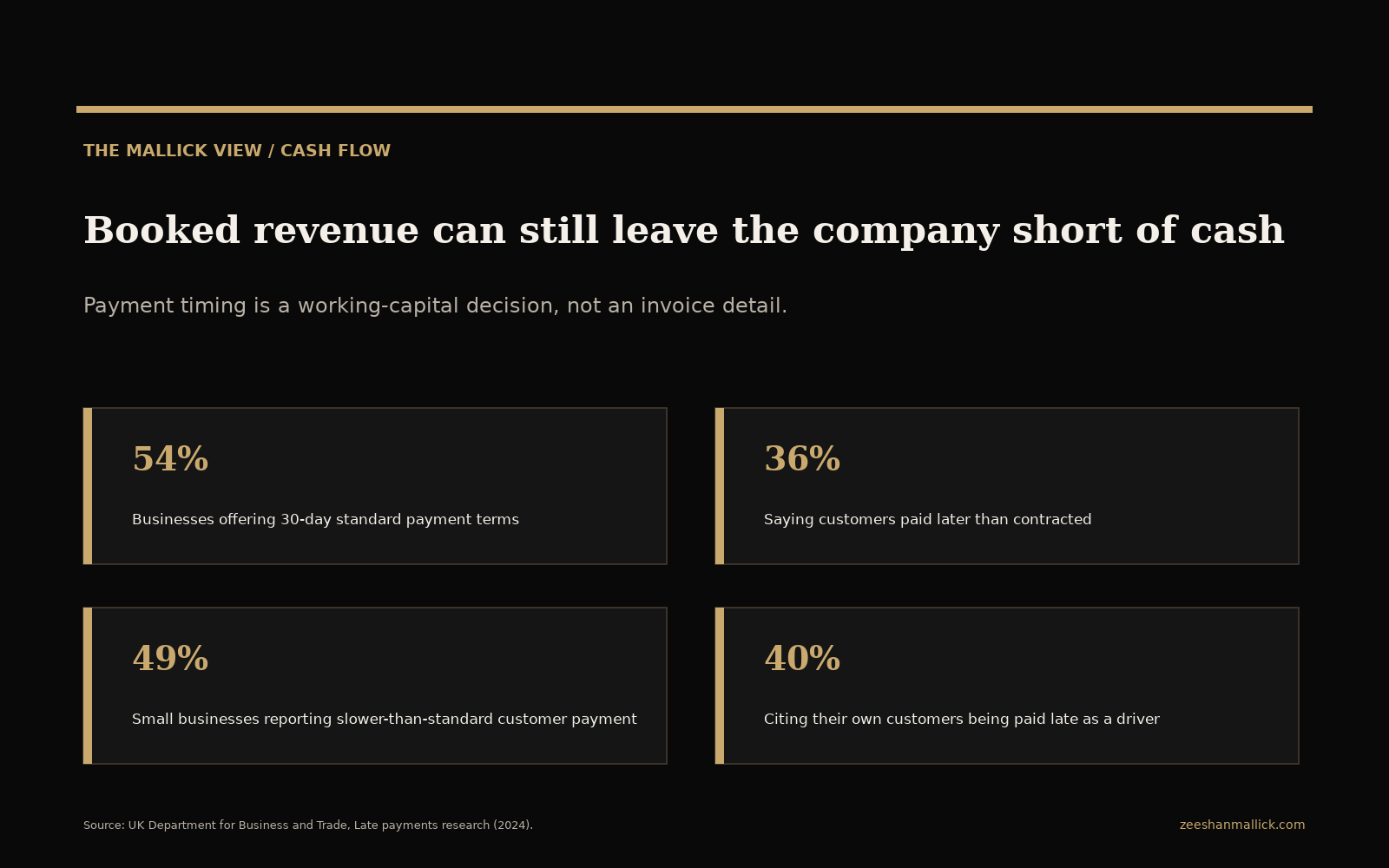
The UK Department for Business and Trade study of 300 interviews found that 54% of businesses with business customers offered 30-day terms, and that 36% said customers paid later than contracted. It also found that 49% of small businesses reported customers paying later than typical agreed terms, and that late payment propagated through supply chains: 40% cited their own customers being paid late as a driver of late payments they received, and 32% of micro businesses reported paying suppliers late because their own customers paid them late. See https://www.gov.uk/government/publications/late-payments-research-performance-and-practices-across-business/late-payments-research-understanding-variations-in-payment-performance-and-practices-across-business-sectors-and-sizes-html-executive-summary for the full study.
Frequently asked questions
Q: If many firms offer 30-day terms, should a founder refuse 30-day payment terms?
A: Not necessarily. The decision should be based on measurement. If offering 30-day terms creates a working-capital gap that cannot be funded without excessive cost, either price those terms or require partial up-front payment. The UK study shows many firms offer 30 days; the risk is the difference between contractual terms and actual payment timing.
Q: Are late payments a small problem for small firms only?
A: No. The study shows that late payment affects firms of all sizes, but small firms are more vulnerable: 49% of small businesses reported customers paying later than their typical agreed terms, higher than the 36% average.
Q: Should founders take short-term finance to cover payment delays?
A: That is an operational decision. Short-term finance can be a deliberate, priced solution to an identified working-capital gap. The prudent approach is to compare explicit financing costs to the implicit cost of unpriced payment terms and to use finance where it lowers overall risk.
Sources
- https://www.gov.uk/government/publications/late-payments-research-performance-and-practices-across-business/late-payments-research-understanding-variations-in-payment-performance-and-practices-across-business-sectors-and-sizes-html-executive-summary
Continue the conversation
Master Collective Newsletter
Receive concise perspectives on founders, capital and strategic growth.