Your Board Meeting Is Not a Status Meeting. It Is a Decision System.
Founders should use board time to make decisions, set governance, and record accountability. Set two to three decisions, send materials early, pick directors to fill real weaknesses, and record owners and deadlines.

Founders should treat the board as a decision system. Board time is for choices, governance, and accountability—not a long status presentation. Frame a few specific decisions, pick directors who fill real gaps, and record owners and deadlines.
Frame two or three decisions
A useful rule is to bring two or three clear, specific decisions to each meeting so the board's time focuses on trade-offs and commitments. Venture firm guidance recommends presenting two to three strategic decisions for discussion rather than a long status tour; regular meetings for VC-backed startups commonly occur every six weeks to quarterly. See CRV for these recommendations and the suggested meeting cadence.
Prepare and distribute materials early
Keep updates brief in the meeting: advice from investors is to limit updates to 15–20 minutes to leave time for decisions. Distribute materials five to seven days before the meeting and circulate minutes within 48 hours so owners and deadlines are clear. These timing recommendations come directly from investor guidance. See CRV for the 15–20 minute update, five to seven day distribution, and 48-hour minutes guidance.
Choose directors to cover real weaknesses
The board is the formal governance construct with duties like CEO hiring and fiduciary duties of care, loyalty, and confidentiality; one practical implication is to nominate directors who address the company's real weaknesses when the board is formed or refreshed. The University of Arizona explains these governance duties and recommends assessing company weaknesses when selecting directors. See Tech Launch Arizona / University of Arizona for background on these duties and selection guidance.
Independent directors often arrive when control is shared
Independent directors commonly join a startup's median board after the second financing, when equity and control begin to be shared; at that stage they can play mediating and advising roles. This pattern and role description come from empirical work. See NBER Working Paper 27769 by Ewens and Malenko for the finding that independent directors join after the second financing and for analysis of their roles.
Run the meeting as a decision system
Practical meeting mechanics matter: use advance agendas, time-boxed items, a consent agenda for routine approvals, explicit feedback loops, and document decisions with clear owners and deadlines. These practices are recommended for effective governance and meeting outcomes. See the National Council of Nonprofits guidance on advance agendas, time-boxing, consent agendas, feedback loops, and documenting decisions and owners.
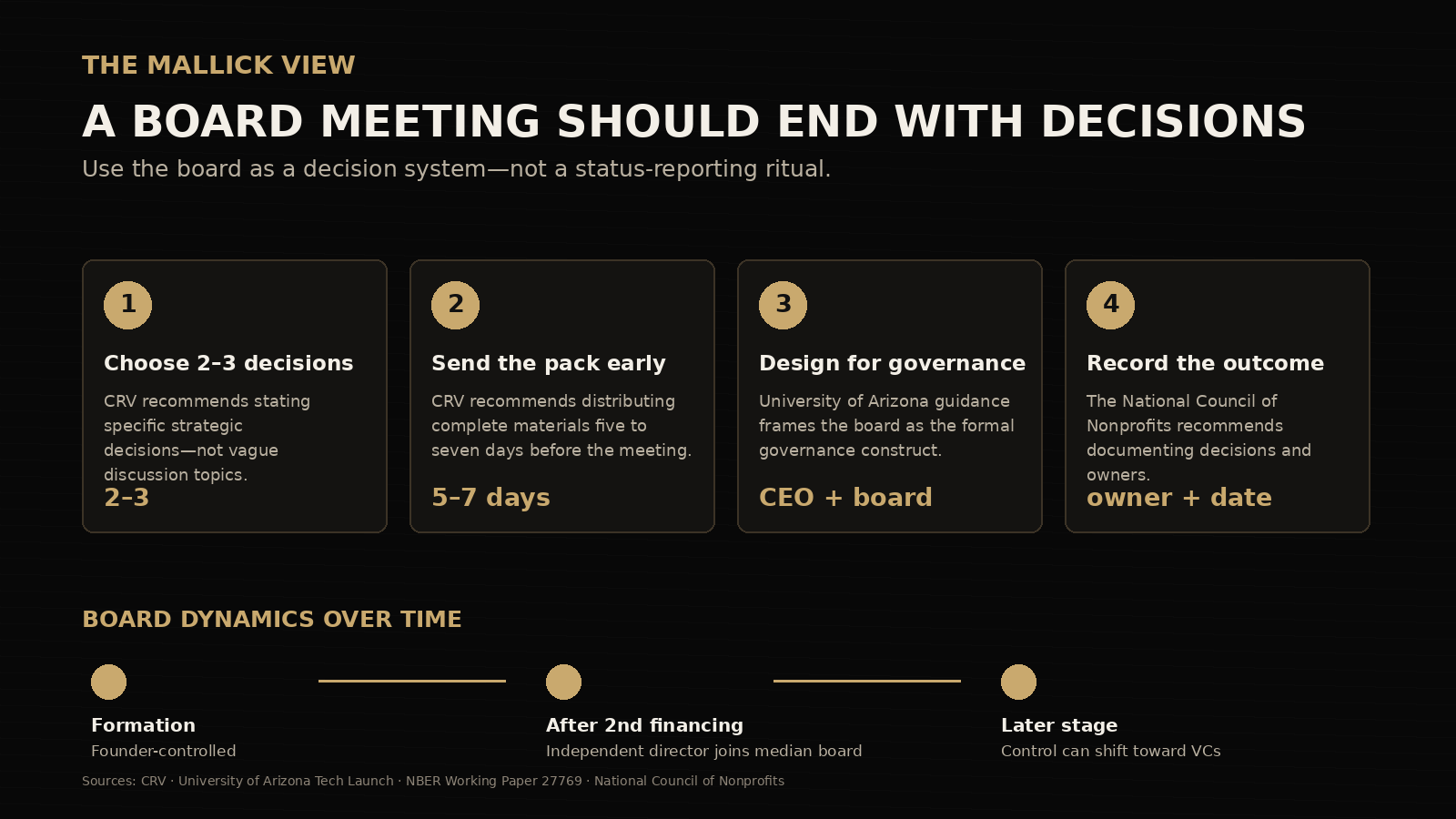
Accessible comparison
| Status Meeting | Decision System |
|---|---|
| Long slide decks and updates | Two to three specific decisions, short updates |
| No clear owners or deadlines | Each decision has an owner and a deadline |
| Unclear director roles | Directors chosen to cover real weaknesses |
Practical operator checklist
- Decide 2–3 concrete motions or choices before the meeting.
- Limit prepared presentation of updates to 15–20 minutes so the board can discuss decisions (CRV).
- Send materials 5–7 days in advance (CRV).
- Assign directors to specific company weaknesses discussed at the meeting (Tech Launch Arizona / University of Arizona).
- Record decisions, owners, and deadlines and circulate minutes within 48 hours (CRV).
- Use agenda time-boxing, consent agendas, and feedback loops (National Council of Nonprofits).
- Schedule an explicit follow-up review of decision execution at the next board meeting.
How many decisions should a founder bring?
Bring two or three focused decisions. Venture guidance suggests bringing two to three strategic decisions so the board can vote, advise, or commit resources rather than sit through a long status update; many VC-backed boards meet on a cadence ranging from every six weeks to quarterly (CRV).
When should pre-reading be sent?
Send materials five to seven days before the meeting and plan to keep in-meeting updates short (15–20 minutes) so directors arrive prepared and discussion time is preserved; circulate minutes within 48 hours after the meeting (CRV).
Who should be on the board?
Choose directors who fill the company’s real weaknesses and can help in governance tasks like CEO oversight; the University of Arizona explains the board’s governance duties and recommends assessing company weaknesses when selecting directors (Tech Launch Arizona / University of Arizona). Independent directors often join after the second financing and can mediate or advise at that stage (NBER).
Sources
- CRV — How to prepare for a board meeting (recommendations on cadence, 2–3 decisions, 15–20 minute updates, 5–7 day materials, 48-hour minutes)
- Tech Launch Arizona / University of Arizona — Startup governance (CEO hiring, duties of care, loyalty, confidentiality; selecting directors)
- NBER Working Paper 27769 — Ewens & Malenko (independent directors join after second financing)
- National Council of Nonprofits — Effective board meetings (advance agendas, time-boxing, consent agendas, feedback loops, document decisions)
Links
- Homepage
- Story
- Ventures
- Book Me — Book a Call
- Related: Option pool and grant discipline
- Related: Angel portfolios and follow-on rule
- Related: Fundraising and unit economics
- Organization mention: Master Collective
This is educational editorial content and not legal, tax, investment, or financial advice.
Master Collective Newsletter
Receive concise perspectives on founders, capital and strategic growth.