Three “Small” SAFEs Can Sell 30% of Your Company Before Series A
A SAFE is not ownership-free bridge money. Zee shows how three simple post-money SAFEs can sell 30% before Series A and leave founders at 56% after the next round.
The direct answer
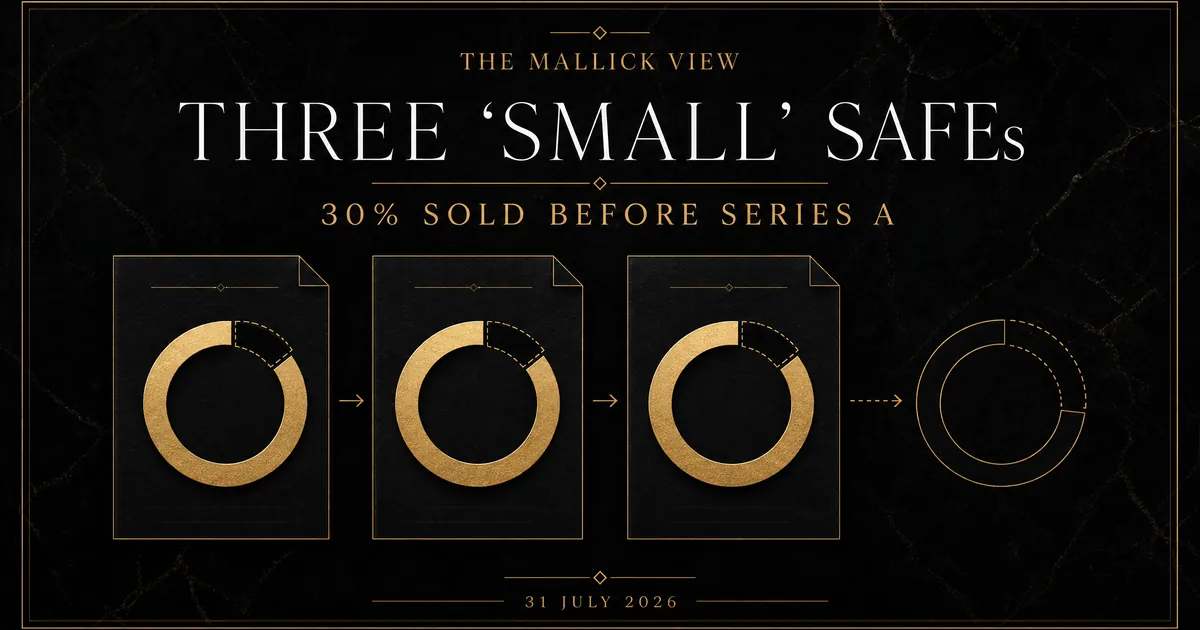
Zee’s view is blunt: a post-money SAFE is an ownership sale with delayed share delivery. It is not free bridge money. If a founder signs three SAFEs that each sell 10%, the company has sold 30% before the Series A starts. If the Series A then buys 20% of the company, the founders’ original 100% falls to 56% in this simple example.
The SAFE can still be a useful tool. The mistake is calling it small because the document is short or the cash arrives quickly. The right question is not only, “How much money came in?” It is, “How much of the company has already gone out?”
Key takeaways
- Y Combinator says a post-money SAFE lets founders calculate immediately how much ownership has been sold.
- Carta says SAFEs represented 90% of pre-seed rounds on its platform in Q1 2025.
- Several post-money SAFEs can stack directly against founder ownership.
- A later priced round can dilute both founders and SAFE holders again.
A SAFE is simple paperwork, not simple ownership
Y Combinator introduced the SAFE in 2013 and the post-money version in 2018. YC says modern SAFE seed rounds are better seen as separate financings, not just bridges into a later round. It also says the post-money SAFE lets both sides calculate immediately and precisely how much ownership has been sold.
That sentence should end the myth. The shares may arrive later, but the economic slice can be measured now. A founder who signs the document without running the ownership table is not postponing valuation. The founder is postponing understanding.
The U.S. SEC warns that a SAFE is not current common stock and may not be simple or safe despite its name. Terms can differ, and conversion depends on stated events. That is why the actual document matters more than the label.
Three small cheques can sell a large slice
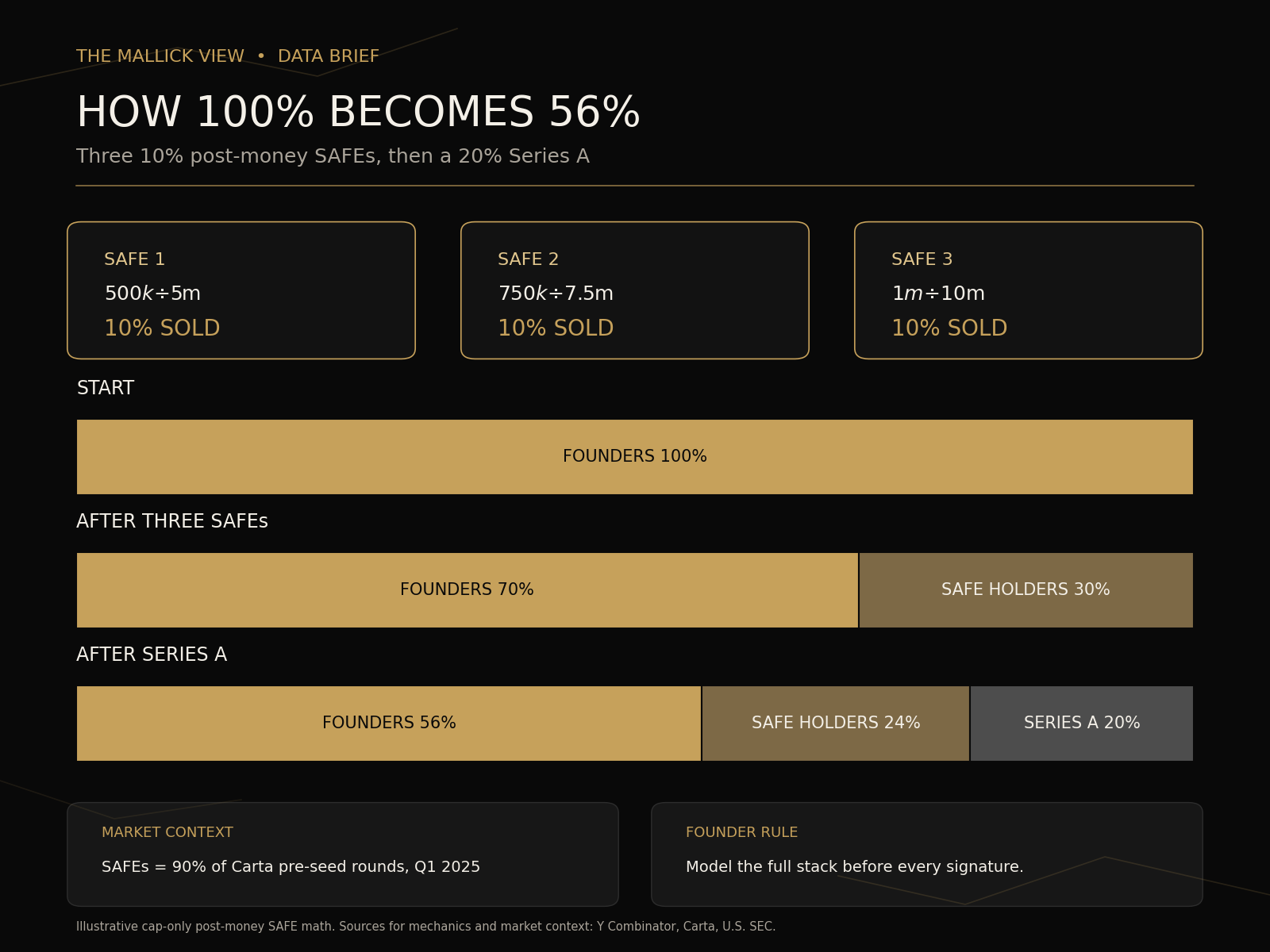
Consider a clean illustration. The founders start with 100%. They sign three cap-only post-money SAFEs. Each investment is 10% of its stated post-money valuation cap. The example leaves out discounts, MFN rights, options, pro rata rights, and other terms so the ownership effect is easy to see.
| Event | Cash and cap | Ownership sold | Founder ownership left |
|---|---|---|---|
| Start | No outside money | 0% | 100% |
| SAFE 1 | $500k at $5m post-money | 10% | 90% |
| SAFE 2 | $750k at $7.5m post-money | 10% | 80% |
| SAFE 3 | $1m at $10m post-money | 10% | 70% |
| Series A | New investor buys 20% post-money | Existing holders diluted by 20% | 56% |
Before Series A, the three SAFE holders own 30% in this simplified case and founders own 70%. When the new Series A investor buys 20% post-money, every existing holder is multiplied by 80%. Founders move from 70% to 56%. SAFE holders move from 30% to 24%. The new investor owns 20%.
This is not an edge case instrument
Carta analysed more than 5,000 convertible instruments in Q1 2025 and more than 110,000 issued since 2020. It reported that SAFEs made up a record 90% of pre-seed rounds on its platform in that quarter and 82% of pre-seed capital raised. U.S. pre-seed companies using Carta raised $737 million across 5,119 convertible instruments.
The tool is common because it can be fast and useful. Common does not mean harmless. A cap table can lose shape through many quick closes because each deal feels small on its own.
Pre-money and post-money SAFEs do not spread dilution the same way
Carta explains that post-money SAFE investors are fixed relative to other SAFE holders. New post-money SAFE investors dilute founders and existing shareholders, not the earlier post-money SAFE investors. With pre-money SAFEs, the SAFE investors can dilute one another as well as founders, so the final percentages remain less certain until conversion.
| Question | Pre-money SAFE | Post-money SAFE |
|---|---|---|
| Can ownership be known now? | Less certain until the priced round | More directly measurable at signing |
| Do later SAFEs dilute earlier SAFEs? | They can | Normally no, relative to other post-money SAFEs |
| Who absorbs a new SAFE? | Founders and SAFE holders may share it | Founders and existing shareholders absorb it |
| Main founder risk | Uncertain final conversion | Quietly stacking known ownership sales |
The valuation cap is not a trophy
Founders often celebrate a higher cap because it sells less ownership for the same cheque. That can be true. But the cap is not cash in the bank, an independent valuation, or proof of product-market fit. It is a conversion term.
One SAFE at a good cap can still become a bad stack when more SAFEs follow. The founder needs one live model showing every SAFE, discount, cap, MFN clause, option grant, pro rata right, and expected priced-round dilution.
Zee’s founder rule
Before every signature, the founder should update three numbers: ownership sold by this SAFE, ownership sold by all SAFEs together, and founder ownership after the next realistic priced round. If the company cannot state those numbers in one sentence, it is not ready to close.
Zee’s rule is not “never use a SAFE.” It is “never call a SAFE small until the cap table proves it.” Fast money can be sensible. Blind dilution is not speed. It is a bill sent to the founder’s future self.
Readers can see the experience behind Zee’s view on his story page and the companies listed under ventures. A founder who wants to test a SAFE stack before signing can book a direct conversation.
Frequently asked questions
Does a SAFE give an investor shares immediately?
No. A SAFE is a contract for future equity if its trigger terms are met. It is not current common stock.
How much ownership does a post-money SAFE sell?
In a simple valuation-cap-only illustration, the investment divided by the post-money cap shows the ownership sold before the priced-round new money. Actual documents can change the result.
Can several SAFEs dilute a founder?
Yes. With post-money SAFEs, each new SAFE can add a measurable ownership sale that is absorbed by founders and existing shareholders.
Does Series A cause more dilution?
Usually yes. New priced-round shares dilute the founders and converted SAFE holders unless another term changes the calculation.
Is a SAFE bad for founders?
No. It can be fast and useful. The danger is signing without modelling the full stack and the next round.
What should a founder do before signing?
Model the actual document, review the cap table, test the next round, and get qualified legal and finance advice.
Sources and method
The instrument facts come from Y Combinator, the U.S. SEC, and Carta. The 100% to 70% to 56% waterfall is transparent arithmetic using three illustrative cap-only post-money SAFEs and a later investor buying 20% post-money. It is not a market forecast or legal opinion. Real results depend on the signed documents, capitalization definitions, discounts, options, pro rata rights, and priced-round terms.
Master Collective Newsletter
Receive concise perspectives on founders, capital and strategic growth.