The ‘Simple’ SAFE Is Your First Priced Round: Stop Calling Dilution a Future Problem
Zee argues that a stack of simple SAFEs can quietly sell a large slice of a company before a priced round ever begins.

Direct answer
Direct answer: A post-money SAFE is not a harmless promise about a future round. It is a present sale of future ownership. Zee’s view is simple: if a founder cannot state the total percentage sold across every signed SAFE, the founder is not ready to sign another one.
The controversial point is that founders call a SAFE simple because it is short. That is the wrong test. A short document can still sell a large part of a company. Y Combinator says its post-money SAFE lets both sides calculate precisely how much ownership has been sold, and says that modern SAFE seed rounds are better seen as separate financings rather than bridges.[1] The document may be simple. The ownership sale is not.
Key takeaways
- Every signed post-money SAFE should be added to one ownership view before another is issued.
- A high valuation cap does not protect a founder if several caps have already sold a large total slice.
- Optional pro-rata rights and later priced-round terms can add more complexity than the headline cap shows.
Why the easy instrument can become the hard cap table
YC designed the post-money SAFE so founders can calculate the ownership sold after all SAFE money is counted but before new money enters a later priced round.[1] That clarity is useful only when it is used. The failure is not the SAFE itself. The failure is treating each close as a small isolated decision.
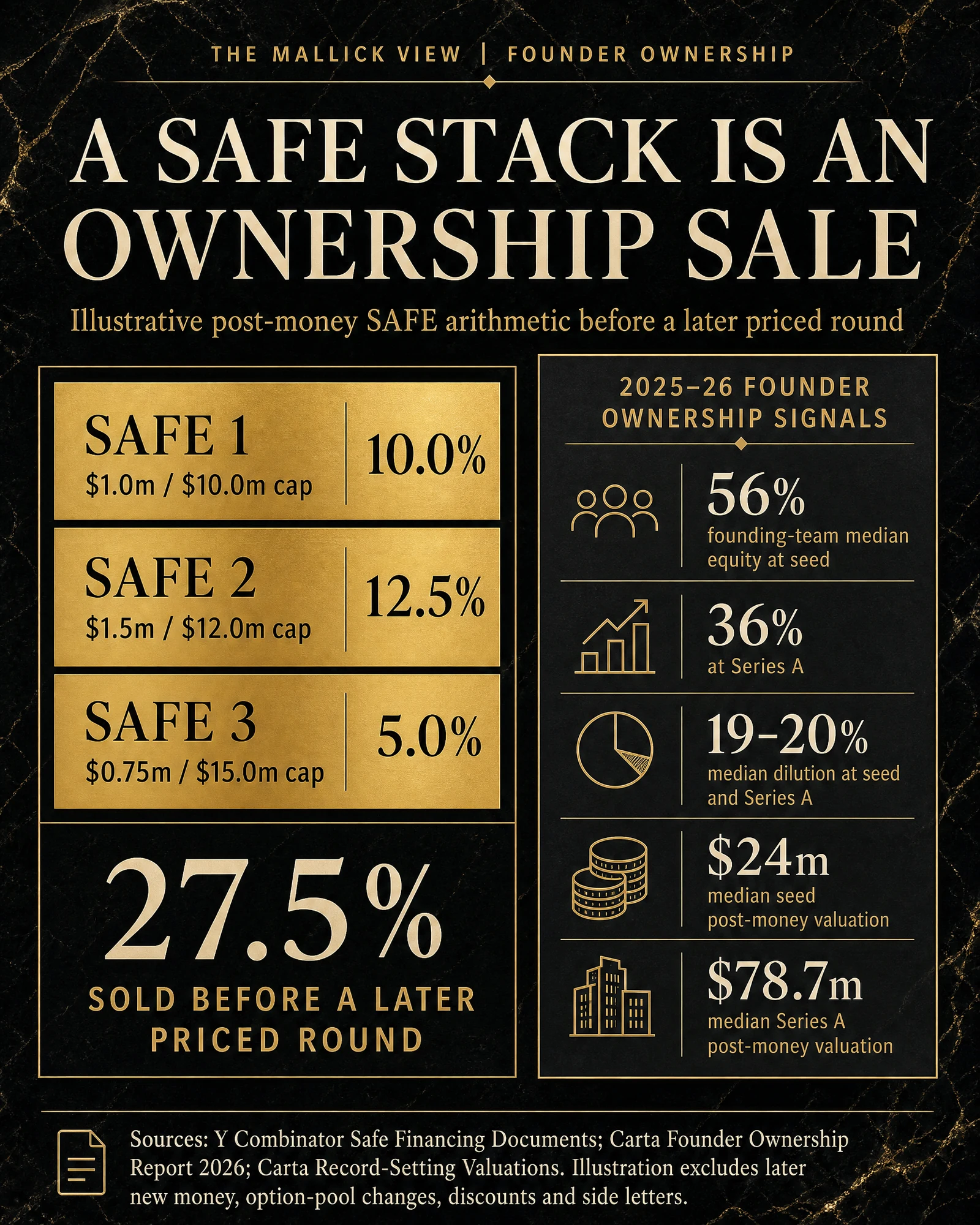
The market makes discipline more important, not less. Carta reports that the median founding team retained about 56% of fully diluted equity by seed and 36% by Series A, based on rounds raised from 2021 through 2025.[2] These figures do not prove that SAFEs caused the decline. They show why a founder should count every early ownership sale.
| Shortcut question | Ownership-first question | Why it matters |
|---|---|---|
| Can this investor wire this week? | What percentage has every signed instrument sold in total? | Fast closes can hide cumulative dilution. |
| Is the valuation cap high? | What is the combined ownership implied by all caps? | Several attractive caps can still add up to a large slice. |
| Is the SAFE standard? | Are there side letters, MFN rights, discounts or pro-rata rights? | Standard forms can be paired with non-standard rights. |
| Will Series A solve this? | What happens before and after the next new-money round? | Later investors and option-pool changes can dilute everyone again. |
An illustrative SAFE stack
Illustrative arithmetic, not a cap-table calculation: consider three cap-only post-money SAFEs. A $1.0m SAFE at a $10.0m post-money cap represents 10.0%. A $1.5m SAFE at a $12.0m cap represents 12.5%. A $0.75m SAFE at a $15.0m cap represents 5.0%. Together, that is an illustrative 27.5% ownership slice before a later priced-round investor, an option-pool change, or other instruments are modelled.
| Illustrative SAFE | Amount / post-money cap | Illustrative ownership slice |
|---|---|---|
| Investor 1 | $1.0m / $10.0m | 10.0% |
| Investor 2 | $1.5m / $12.0m | 12.5% |
| Investor 3 | $0.75m / $15.0m | 5.0% |
| Total before a later priced round | — | 27.5% |
This example is deliberately plain. Real outcomes depend on the documents, the conversion mechanics, any discount, option-pool treatment, later financing, side letters and the company’s jurisdiction. It is not legal advice. Its purpose is to make the hidden question visible: how much of the company has already been sold?
Valuation headlines do not remove dilution
Carta reported a median Q4 2025 post-money valuation of $24m at seed and $78.7m at Series A. It also reported that median dilution at those stages remained around 19–20%.[3] Higher prices can be good. They do not repeal ownership maths.
Capital is also concentrated. Carta says the top 10% of US startups that closed a round in 2025 raised about half of all cash, while the bottom 50% combined raised 14%.[3] That is a warning against copying a standout company’s terms simply because the headline looks impressive. A founder should negotiate for the company that exists, not for the outlier story on social media.
The better pre-signing conversation
Zee would ask for a single fully diluted ownership model before each new SAFE is signed. It should show every convertible instrument, its cap or discount, any most-favoured-nation language, side letters, pro-rata rights, the current option pool and a reasonable priced-round scenario. YC’s document page includes an optional pro-rata side letter, while NVCA’s model-document library shows that venture financing involves a wider set of investor-rights and governance documents.[1] [4]
| Before signing | Ask for | Purpose |
|---|---|---|
| Ownership view | One fully diluted cap table including all signed SAFEs | Shows the total already sold. |
| Conversion view | A priced-round scenario with new investor and option-pool assumptions | Shows what the next round may do. |
| Rights view | All side letters, pro-rata rights, MFN clauses and information rights | Shows terms beyond the valuation cap. |
| Decision record | Board, counsel and finance review before closing | Creates a deliberate decision rather than a rushed close. |
The right answer is not never use a SAFE. The right answer is never use one blindly. A good investor should welcome clear ownership maths. A good founder should know whether the next cheque is funding progress or selling a slice that the company will regret later.
Frequently asked questions
Is a SAFE the same as a priced round?
No. A SAFE is a different instrument. But YC says modern post-money SAFE seed rounds are better thought of as separate financings, because they sell measurable ownership before the later priced round.
Does a high valuation cap mean low dilution?
Not by itself. Dilution depends on the complete stack of instruments, amounts, caps, discounts, option-pool changes and later financing.
Can founders calculate SAFE dilution before Series A?
Post-money SAFEs were designed to make the ownership sold measurable. Founders should model the full stack with qualified counsel and cap-table support before signing more instruments.
Are pro-rata rights always bad for founders?
No. They can help existing investors maintain ownership and may be part of a fair deal. Founders should understand who has the right, how much of a future round it may cover, and how it fits the full financing plan.
What should a founder request before issuing another SAFE?
Request a current fully diluted ownership model, every signed side letter, and a simple model for a future priced round. Review the documents with qualified legal and finance advisers.
References
Master Collective Newsletter
Receive concise perspectives on founders, capital and strategic growth.