The “Maybe” Investor Is Costing Founders More Than a “No”
A slow, vague investor can drain a founder’s time, runway and negotiating power. Zee’s rule is simple: seek qualified conviction, not endless soft interest.

Direct answer
Direct answer: A vague investor can be more expensive than a clear rejection. A ‘maybe’ that has no decision date can consume a founder’s time, weaken urgency and burn runway. Zee’s view is simple: founders should look for qualified conviction, not a long list of soft signals.
The controversial part is this: founders are often taught to keep every investor warm. Zee thinks that can be a mistake. A good investor conversation should create one of two useful outcomes: a clear next step with a date, or a respectful no. Everything else needs a limit.
Key takeaways
- A vague investor with no decision date is a runway risk, not a neutral lead.
- A strong market headline does not mean every company has equal access to capital.
- The best next step is a named decision-maker, missing proof and a clear date.
Why a “maybe” is not neutral
A delayed answer feels safer than a rejection. It is not. It can keep a founder rewriting a deck, postponing product work and waiting for a partner meeting that may never happen. It also makes the next investor wait, because the founder is trying to protect the first conversation.
“A decision without a date is not a decision.”
Zee’s principle is not to rush investors. It is to protect focus. The founder should ask what proof is missing, who will decide and when the decision is expected. If those answers stay unclear, the conversation belongs in a low-priority follow-up list.
What the current market actually says
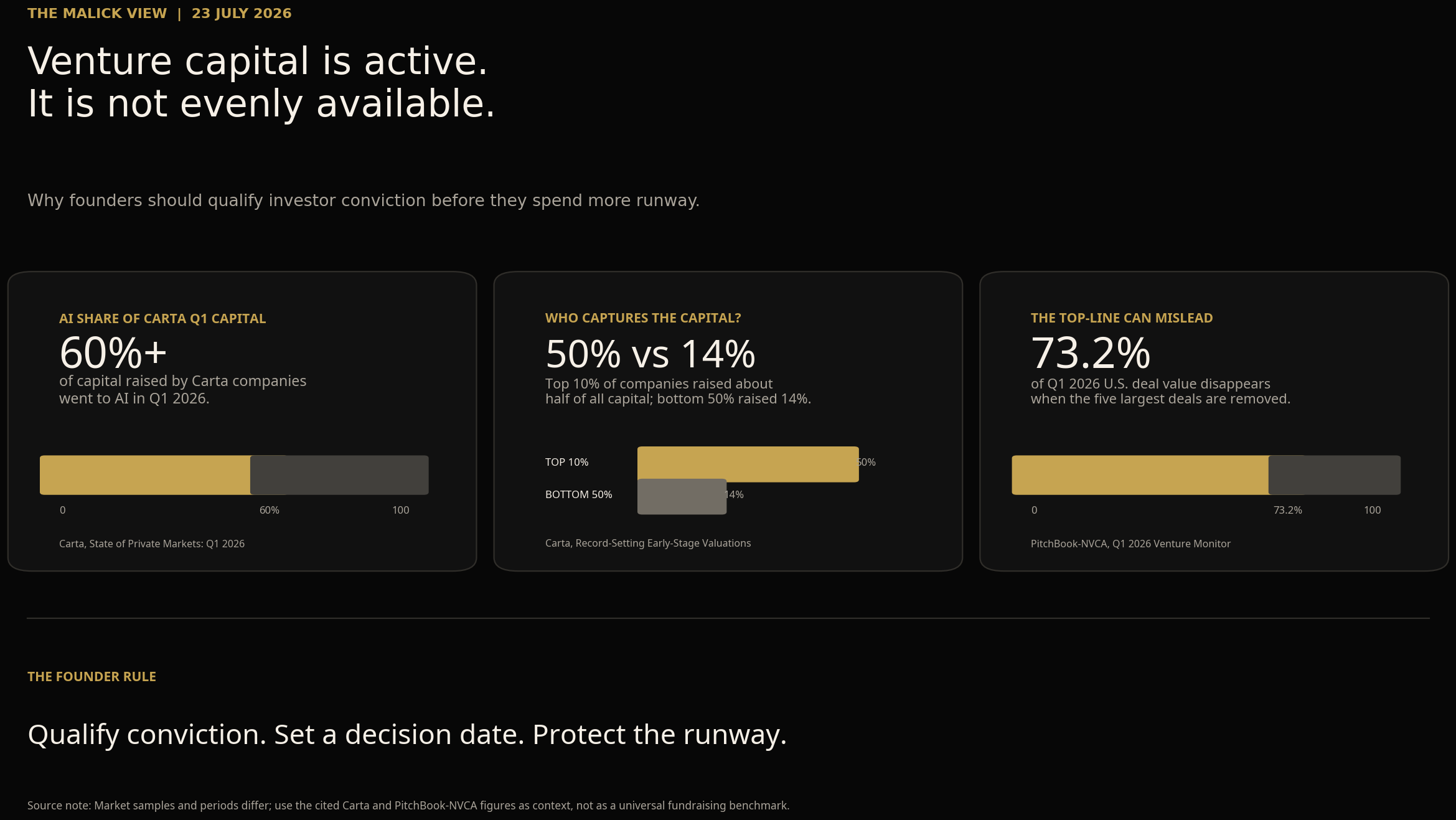
Headline venture numbers can make the market look open to everyone. The details say otherwise. Carta reported that more than 60% of capital raised by companies on its platform in Q1 2026 went to AI companies. That does not mean non-AI businesses cannot raise. It means founders must not use a strong AI headline as proof that their own market has become easy.[1]
The same pattern appears in deal concentration. Carta reported that the top 10% of U.S. startups on its platform that closed a round in 2025 raised about half of all capital, while the bottom 50% raised 14%. PitchBook-NVCA found that removing the five largest deals from Q1 2026 U.S. venture data reduced reported deal value by 73.2%.[2] [3]
| Signal | What it means for a founder |
|---|---|
| More than 60% of Carta Q1 capital went to AI | Do not confuse a hot category with broad investor appetite. |
| Top 10% of Carta companies raised about 50% of cash | Target fit matters more than sending more decks. |
| Bottom 50% raised 14% of cash | Time spent on unqualified ‘maybes’ has a real opportunity cost. |
Price is not the same as fit
Current benchmarks can also distract founders. Carta’s 10 July 2026 software-round dataset shows a median seed post-money valuation of $24.3 million, with $4.1 million raised and 18% median dilution. The same source warns that medians are only guidelines and that each deal is different.[4]
That is important. A valuation is not a trophy. It is the result of how much cash is raised, how much ownership is sold and what the company must achieve next. Zee believes the better question is: will this investor help the company reach the next proof point without forcing the team to spend months managing the relationship?
Zee’s three-question filter
- Is there a real fit? The investor should understand the customer, market or business model well enough to name the next risk.
- Is there a real process? The founder should know who decides, what evidence is needed and the date of the next meeting.
- Is there a real value after the cheque? A useful investor can open relevant doors, challenge weak assumptions and remain available when the plan changes.
If one answer is missing, the founder does not need an argument. The founder needs a boundary. A short message can say: “Thank you. We will return when there is a defined next step.” That protects the relationship without allowing it to control the company’s calendar.
The hard truth for founders
More investor names do not automatically create more leverage. Strong leverage comes from a small group of investors who understand the company, have a reason to act and can move on a known timetable. A founder who is clear about fit can say no to false progress. That is not arrogance. It is operating discipline.
Zee applies the same logic to investor-founder matching: the goal is not a larger room. It is a better room. Founders who want a clearer growth and capital strategy can explore Zee’s ventures, read more in The Mallick View, or book a direct conversation.
For more on Zee’s operating principles, read Zee’s story.
Frequently asked questions
Should a founder reject every slow investor?
No. A founder should stay respectful, but move a vague conversation to a low-priority list until there is a clear next step and decision date.
What is qualified conviction?
It means the investor understands the company, can name the proof they need and has a real process to make a decision.
Why does a decision date matter in fundraising?
A date protects the founder’s calendar and cash runway. It turns interest into a process that can be managed.
References
Master Collective Newsletter
Receive concise perspectives on founders, capital and strategic growth.