The Exit Number Is Not Your Number. Liquidation Preferences Get Paid First.
A headline sale price is not the founder payout. Zee explains how liquidation preferences and participation can move millions away from common shareholders before an exit is shared.

The direct answer
Zee’s view is simple: the exit number is not the founder’s number. A company may sell for $20 million, $40 million, or $80 million, but that headline does not say what founders and employees receive. Debt, fees, taxes, and preferred-stock rights are paid through a waterfall. Common shareholders wait behind those rights.
A founder should never discuss valuation without also asking who gets paid first at exit. A high price with a harsh preference can be worse than a lower price with clean terms.
Key takeaways
- A liquidation preference is a payout right, not a headline ownership percentage.
- A 1x non-participating investor normally chooses the preference or converts to common, whichever pays more.
- A fully participating investor can take the preference first and then share the remaining proceeds.
- Founders should model the exit waterfall at several sale prices before signing a term sheet.
Preferred stock is paid before common stock
Founders and employees usually hold common stock. Venture investors often hold preferred stock. Fidelity Private Shares explains that liquidation preference gives preferred holders the right to receive proceeds before common holders. Morrison Foerster calls it a core economic right in venture financing.
The multiple matters. AngelList says 1x is the most common multiple. A 1x preference means the investor can receive the original investment before junior holders are paid. A 2x preference can return twice the investment first. That does not mean the investor owns twice as much. It means the investor stands closer to the front of the payout line.
NVCA’s model legal documents are industry starting points. They present several possible terms. They are not a promise that every deal is clean, and they are not a reason to skip the math.
The same exit can produce three different founder outcomes
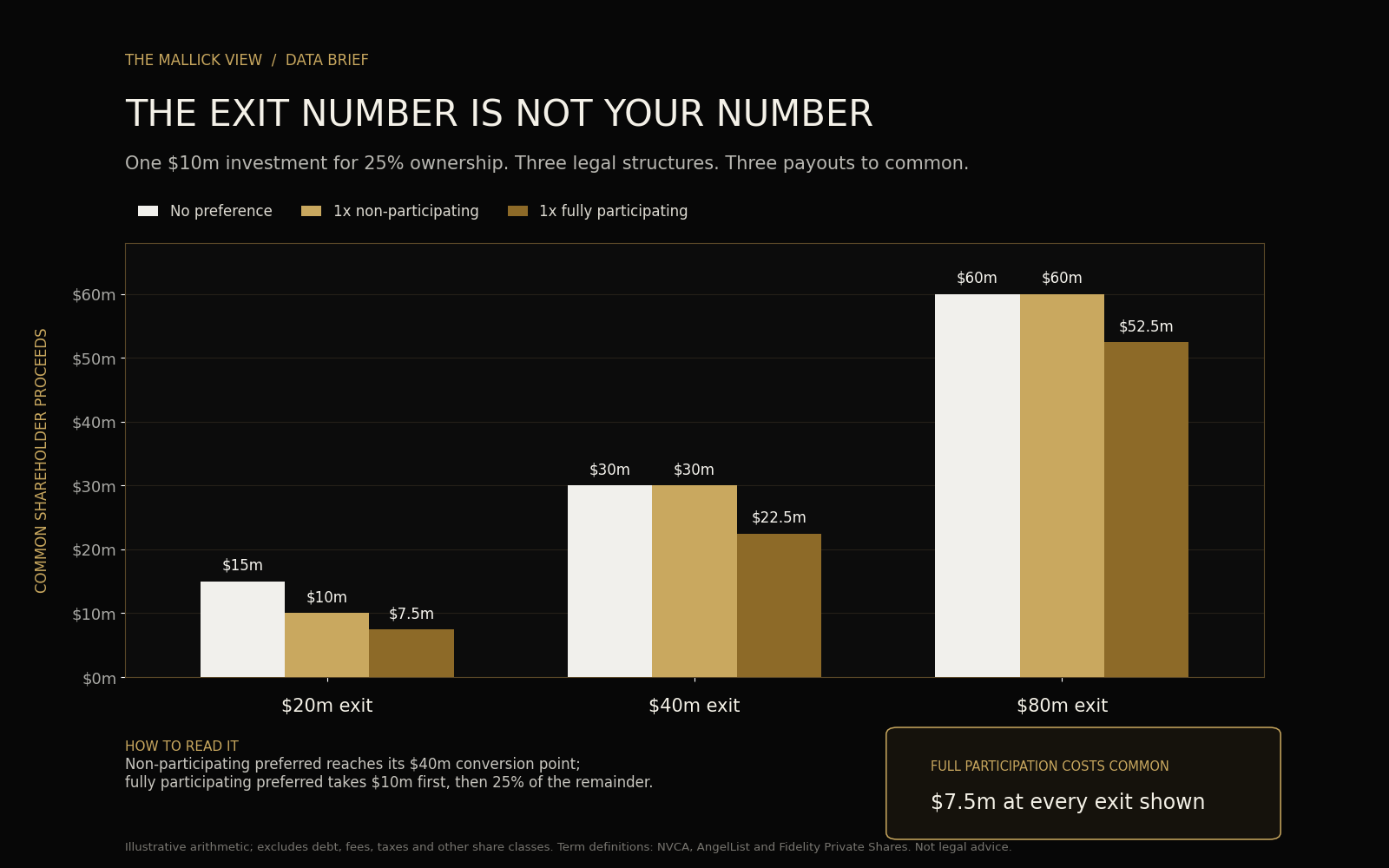
Consider a simple example. One investor puts in $10 million for 25% ownership. Founders and employees together own the other 75%. The table excludes debt, fees, taxes, and other investor classes so the effect of one term is easy to see.
| Exit value | No preference | 1x non-participating | 1x fully participating |
|---|---|---|---|
| $20 million | $15.0m | $10.0m | $7.5m |
| $40 million | $30.0m | $30.0m | $22.5m |
| $80 million | $60.0m | $60.0m | $52.5m |
Under the 1x non-participating term, the investor takes $10 million at a $20 million exit. At $40 million, 25% ownership is also worth $10 million, so this is the conversion point. Above it, conversion to common pays more. LTSE explains the same choice: preference protects the lower exit, while conversion becomes useful when the common share is worth more.
The fully participating term is different. The investor takes $10 million first, then receives 25% of what remains. Common holders receive $7.5 million less in every illustrated case. Fidelity describes this as a double dip. The words are technical. The transfer is not.
Investor-friendly structure is not imaginary
Carta reported that liquidation preferences of 1x or higher appeared in 8% of new rounds on its platform in Q1 2024, tied for the highest quarterly rate of the decade. Carta also found more use of terms such as participating preferred shares and cumulative dividends after the market shifted toward investors.
Eight percent is not most deals. It is still enough to reject a lazy answer such as, “Nobody asks for that.” Kroll says senior preferences can help a company raise survival capital, but they can also reduce returns to junior and common equity in low- and mid-value exits.
Zee does not say every preference is unfair. Investors take real risk. Downside protection can make a deal possible. His argument is narrower: founders must price the protection. A term is not harmless because it looks normal in a document.
Valuation is only one line of the deal
| Question | Why it matters | Danger sign |
|---|---|---|
| What is the preference multiple? | It sets the amount paid before common. | More than 1x without a clear reason. |
| Does preferred participate? | Participation can pay the investor twice. | Uncapped full participation. |
| Which round is senior? | Later investors may be paid before earlier holders. | A stack no one has modelled. |
| What happens at a modest exit? | That is where preference changes outcomes most. | Only showing a billion-dollar case. |
| Can the term be capped or removed? | A cap can limit the transfer from common. | “Standard” used instead of an answer. |
Zee’s founder rule
Model at least five exit values before signing: below invested capital, equal to invested capital, two times invested capital, the last post-money valuation, and a strong upside case. Show the payout for every class. Then show the result per founder and for the employee pool.
If the investor will not let the company model the waterfall, that is not a finance problem. It is a trust problem. If the founder will not take time to understand it, that is not speed. It is neglect.
Readers who want the context behind Zee’s founder view can review his story and the companies covered under ventures. A founder who wants to test an exit waterfall before signing can book a direct conversation.
Frequently asked questions
What is a liquidation preference?
It is a contractual right that says preferred shareholders receive a stated amount before junior or common shareholders receive exit proceeds.
Does a 1x preference give the investor 100% ownership?
No. It sets payout priority. Ownership percentage and payout priority are different numbers.
When can founders receive nothing?
Founders can receive nothing when debt, fees, taxes, and senior preferred claims use all available proceeds before common stock is reached.
Is non-participating preference always safe?
No. It is cleaner than full participation, but the amount, seniority, dividends, and other preference classes still matter.
Should founders reject every liquidation preference?
No. They should model it, compare it with valuation and dilution, negotiate where needed, and obtain qualified legal advice.
Sources and method
The market statements come from NVCA, Carta, AngelList, LTSE, Fidelity Private Shares, Kroll, and Morrison Foerster. The payout table is transparent arithmetic based on one $10 million investment for 25% ownership. It is an illustration, not a forecast. This article is educational and is not legal, tax, or investment advice.
Master Collective Newsletter
Receive concise perspectives on founders, capital and strategic growth.