The $24M Seed Valuation Trap: Why the Highest Price Can Make Your Next Raise Harder
A record seed valuation is not always a founder win. Zee explains why the right price must support the next proof point, not only flatter the first-round headline.

Direct answer
Direct answer: The highest seed valuation is not always the best deal. Zee’s view is that a founder should choose a price that gives the company enough cash and a credible next milestone. A high price without matching proof can make the next raise harder, because the next investor must believe the company can grow into that price.
The controversial idea is simple: a founder should not celebrate a valuation before asking what it demands next. A $24 million seed valuation can be excellent. It can also become a promise the business cannot keep. Price is not the same as strength.
Key takeaways
- A high seed valuation is useful only when the company has a realistic plan to support the next round.
- Dilution, runway, investor quality and the next proof point matter as much as the headline price.
- The right question is not “What is the highest price?” It is “What price helps this company win the next 18 months?”
Why this matters now
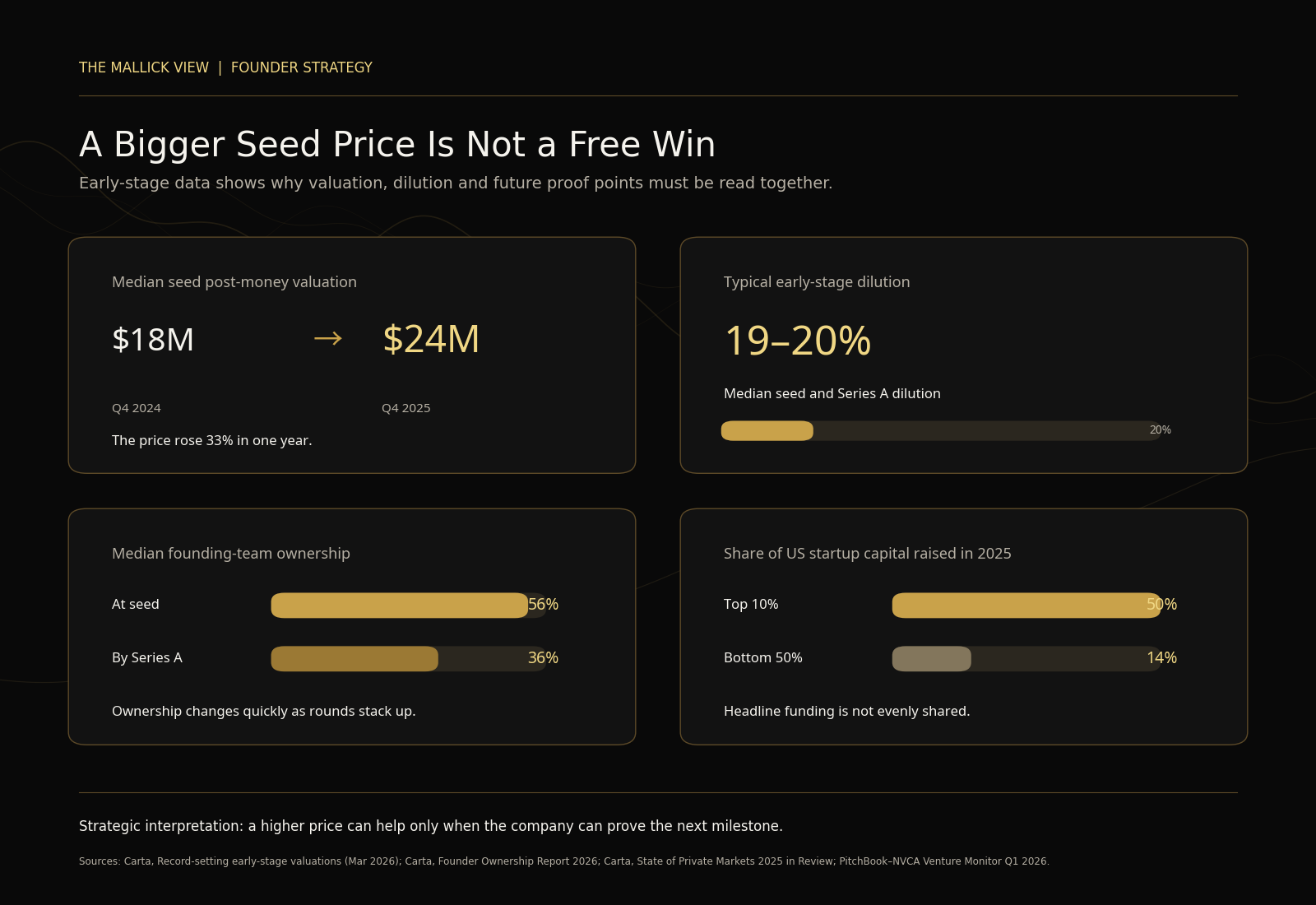
Seed prices are rising fast. Carta reported a median seed post-money valuation of $24 million in Q4 2025, up from $18 million a year earlier. It also reported a median Series A post-money valuation of $78.7 million, up 37% year over year.[1] These are useful benchmarks. They are not a target for every company.
The market is also uneven. The PitchBook–NVCA Q1 2026 Venture Monitor reported $267.2 billion in US quarterly deal value, but said that removing the five largest deals would reduce the number by 73.2%.[2] Zee reads this as a warning for founders: big headlines can describe a few companies, not the average fundraising experience.
| Founder choice | Short-term feeling | What it must support next |
|---|---|---|
| Take the highest headline price | Validation and less visible dilution today | A larger leap in revenue, product proof or market leadership before the next round |
| Take a disciplined, well-supported price | Less headline drama | A clear plan, enough runway and a credible path to the next investor decision |
Ownership is the cost people forget
Valuation is only one part of the deal. Carta says median seed and Series A dilution stayed around 19% to 20%. It also reports that the median founding team holds about 56% of fully diluted equity by seed, falling to 36% by Series A.[1] [3]
That does not mean founders should fear funding. It means they should do the maths before the celebration. A higher valuation can reduce dilution in one round. But it can also lift the evidence needed for the next price. The company still needs enough time, team and capital to reach that evidence.
Zee’s valuation test
Zee uses four plain questions when discussing a seed round. First, how much cash is truly needed to reach the next proof point? Second, what proof will a new investor expect after this round? Third, how much ownership is being sold after the option pool and other terms are counted? Fourth, will the investor help the company reach the next milestone?
If the answer to the second question is vague, the valuation is probably too high for the current stage. That does not make the founder weak. It makes the founder realistic. Strong founders protect the next round before they announce the first one.
The hard truth about investor signals
In 2025, the top 10% of US startups on Carta that raised capital took about half of all cash raised, while the bottom 50% took 14%.[1] A hot deal can attract a high price. That does not prove the price is right for every founder. It proves that investor demand is concentrated.
Zee’s rule is not “raise low.” It is “raise with a plan.” The best valuation is the one that matches the company’s evidence, protects its choices and brings in an investor who can help when the plan changes. Founders who want to discuss capital strategy can explore Zee’s ventures, read more in The Mallick View, or book a direct conversation.
For more on Zee’s operating principles, read Zee’s story.
Frequently asked questions
Is a high seed valuation always bad?
No. A high valuation can be right when the company has strong evidence, a clear use for the cash and a credible next milestone. The problem is a price that the business cannot support later.
What should founders compare besides valuation?
They should compare dilution, runway, the option pool, investor fit, decision speed and the proof needed for the next round.
Does valuation alone decide whether a Series A will work?
No. Product progress, revenue, market timing, team quality and investor appetite all matter. Valuation is one reference point that later investors will assess.
References
Master Collective Newsletter
Receive concise perspectives on founders, capital and strategic growth.