The $24 Million Trap: Why a Bigger Seed Valuation Can Make a Founder Weaker
A high seed valuation can look like a win. Zeeshan Mallick argues that, without a clear proof plan, it can make the next round harder—not easier.

Short answer: A big seed valuation is not automatically a founder win. It can be useful when it reflects real proof and gives the company enough time to build. It can be dangerous when it is only a prize for a hot market. The next investor will not reward a founder for the old headline. They will ask whether the business has grown enough to deserve a higher price.
Zeeshan Mallick’s view is direct: founders should stop treating valuation as proof of quality. Valuation is a price paid by one group of investors at one point in time. It is not product-market fit. It is not revenue. It is not customer love. It is not an exit.
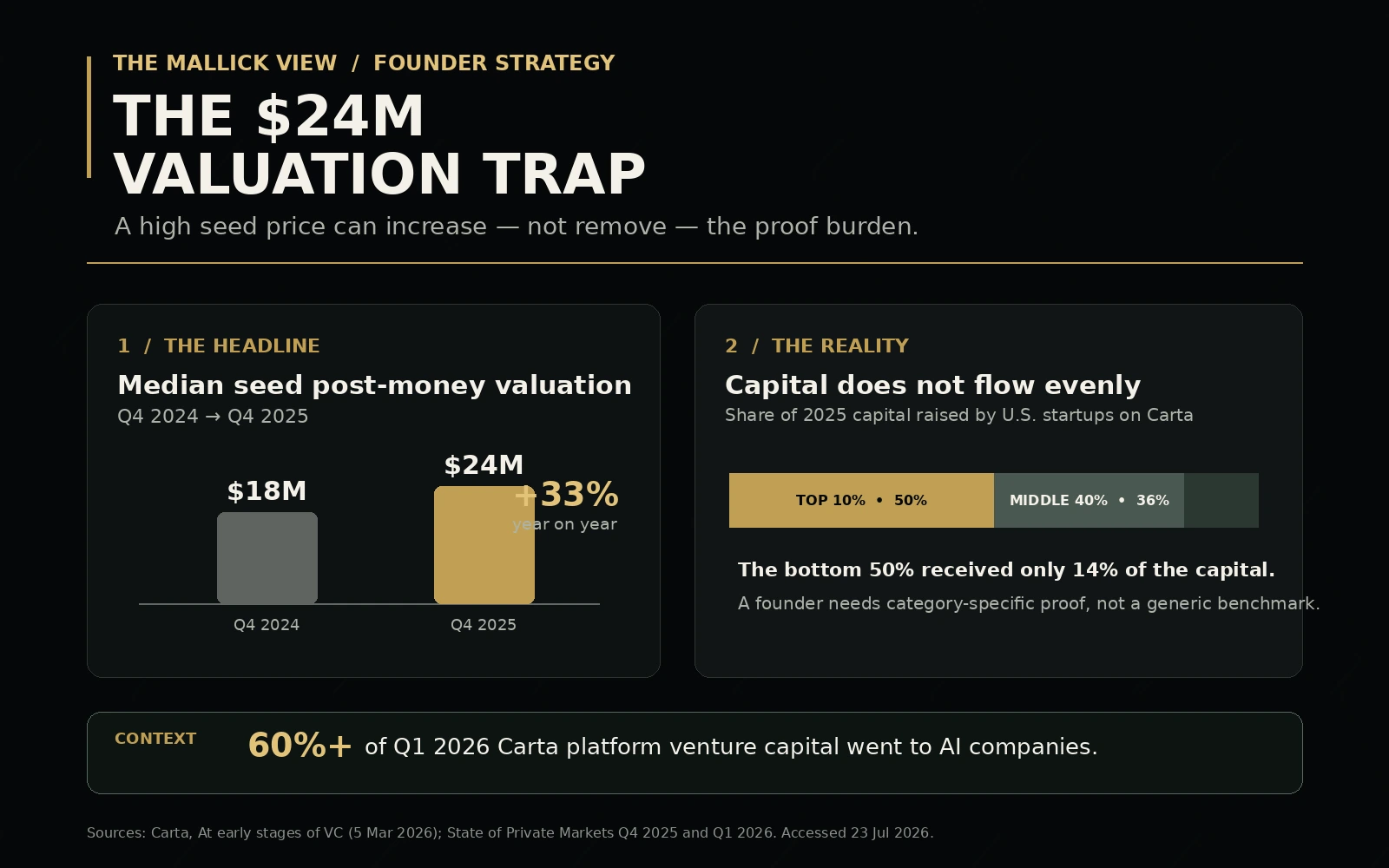
That matters more now because venture capital looks healthy from far away, but the money is not flowing evenly. In the fourth quarter of 2025, the median post-money seed valuation reached $24 million, up from $18 million a year earlier. Yet median seed and Series A dilution still sat around 19% to 20%. Founders are still selling a meaningful piece of the company; they are simply doing it at a louder price. [1]
The real problem: valuation can create a false finish line
A founder who raises at a high valuation may feel safer. In fact, the company may have gained a harder next job. The next round must make sense at a price above the last one. That does not mean a down round is certain. The data does not prove that a high seed price causes one. But it does mean the company must show stronger evidence before new investors can support a higher price.
In simple terms, a high valuation can turn fundraising into an expectation machine. The team may spend more because the round looks large. Hiring plans may become bigger. Growth targets may become noisier. The founder can start managing the story instead of managing the proof.
A valuation is a promise about the future. A milestone is evidence from the present.
The market is not one market
Founders should be careful when they use headline data as a benchmark. Carta reported that more than 60% of venture capital raised by companies on its platform in Q1 2026 went to AI companies. It also reported a $300 million median Series A valuation for foundational-model companies, compared with $55 million for non-AI companies at the same stage. Those are not interchangeable reference points. [2]
The same split appears in who receives capital. In 2025, the top 10% of US startups on Carta that closed a round raised about half of all capital. The bottom 50% raised only 14%. [1] The headline can say “venture is back.” A founder’s real question is different: “Is this money available for a company like mine, with my proof, in my category?”
| What founders hear | What the data says | What a disciplined founder should ask |
|---|---|---|
| “Seed valuations are at records.” | Median post-money seed valuation reached $24m in Q4 2025. | Does that number reflect this company’s customers, retention, margins, and market? |
| “There is plenty of venture money.” | More than 60% of Q1 2026 capital on Carta went to AI companies. | Is the company in the part of the market receiving that capital, or is it using the wrong comparison? |
| “A large round solves risk.” | Median early-stage dilution remained near 19%–20%. | What precise proof will this capital buy before the next financing? |
| “More capital means more opportunity.” | Capital has become concentrated in fewer, larger rounds. | Would a smaller round create more focus and lower the proof burden? |
The $24 million trap
The trap is not the number itself. A $24 million post-money valuation may be sensible for a company with fast customer demand, clear retention, strong unit economics, and a realistic use of cash. The trap is copying the number without copying the evidence.
In 2025, startups on Carta raised $119.5 billion in new funding. That looks strong. But only 4,859 new rounds closed, the lowest annual total in at least six years and 41% below the 2021 high. [3] This is not a wide-open market. It is a selective market with some very large checks.
That distinction is critical. When founders chase the largest visible round, they can make three avoidable errors.
1. They price the company before they can explain the proof
A founder should be able to say, in plain language, what this round will prove. It may prove repeatable sales. It may prove retention. It may prove that a regulated product can be deployed safely. It may prove that a marketplace has enough supply and demand in one city. If the answer is only “we will grow,” the valuation is doing too much work.
2. They confuse dilution with cost
Dilution is not just a percentage in a cap table. It is a long-term transfer of upside and influence. A 19% to 20% round can be right. But it should be judged with the cash plan, investor support, governance rights, and next-round target together. Price alone is not the deal.
3. They turn a fundraising story into an operating plan
The most expensive mistake is to spend according to the story that won the round. A company may be valued as if it will dominate a market. That does not mean it should hire, buy software, or expand geography as if domination already happened. The operating plan should follow customer proof, not investor excitement.
The better rule: raise for proof, not applause
Mallick argues that a founder should work backwards from the next evidence point, not forwards from the biggest available cheque. A strong round has a simple job: it gives the company enough time and money to prove one important thing that changes the quality of the next conversation.
| Vanity round | Proof round |
|---|---|
| Starts with the highest possible valuation. | Starts with the specific milestone that reduces business risk. |
| Uses market headlines as the main benchmark. | Uses comparable customer evidence and category economics. |
| Builds a hiring plan around cash available. | Builds a cash plan around the shortest path to learning. |
| Measures success by press, valuation, and investor names. | Measures success by retention, revenue quality, deployment, or repeatable demand. |
| Assumes the next round will be easier. | Designs the round so the next investor can see the proof without a long story. |
This does not mean founders should accept weak terms or underprice their work. It means they should know why a price is right. A fair valuation with a clear milestone can create more strategic freedom than a record valuation with no room for operational error.
A practical founder test before accepting a term sheet
Before signing, the founder should be able to answer five questions without jargon:
- What exact proof will this capital buy? For example: 20 paying customers with a target renewal rate, regulatory approval, or a repeatable sales channel.
- How long will that proof take? The cash plan should include real hiring time, sales cycles, and a margin for delay.
- What must be true for the next round to be rational? This is not a promise of a valuation. It is a list of evidence a future investor can verify.
- What happens if growth is slower than planned? A credible plan includes a lower-spend path before the cash is gone.
- What is being traded besides ownership? Board rights, preferences, pro rata rights, and investor behaviour matter as much as price.
There is also a useful comparison at pre-seed. In 2025, Carta said median post-money SAFE caps were about $10 million for $250,000–$1 million rounds and $15 million for $1 million–$2.5 million rounds. [4] That does not prescribe a cap. It shows why founders should anchor terms to the amount of capital and proof required, rather than to a viral announcement from another category.
FAQ: the questions founders should ask about a high valuation
Is a high seed valuation bad?
No. It can be right when the company has strong evidence, competitive investor demand, and a capital plan that turns money into proof. It becomes risky when the price is disconnected from the work needed for the next stage.
Does a high valuation cause a down round?
No single data point proves that. A down round depends on many things: product execution, market change, cash burn, investor appetite, and the old price. The practical point is simpler: a higher existing price can make the next investor ask for stronger evidence before paying more.
Should a founder always raise less?
No. Some companies need more capital because they have long sales cycles, regulatory work, hardware, clinical development, or expensive infrastructure. The right amount is the amount required to reach a real milestone with a credible buffer.
What is the best fundraising metric?
There is no single best metric. The best proof is the measure that removes the largest risk in the company’s model. For a SaaS company, that may be retention. For a marketplace, it may be repeat activity. For a regulated business, it may be deployment or approval. For a consumer product, it may be repeat purchase with workable acquisition economics.
The conclusion
The venture market has money. It also has a sharp filter. The data shows record valuations, large rounds, and a powerful AI premium. It also shows concentration: fewer deals and more capital flowing to a small share of companies. [5]
That is why founders should not build their strategy around the loudest valuation in the room. They should build it around the next hard fact their company can prove. The best round is not the one that produces the biggest headline. It is the one that makes the next stage of the company more true.
This article is general information and founder strategy commentary, not legal, tax, or investment advice.
References
- Carta, “At early stages of VC, rising round sizes and record-breaking valuations” (5 March 2026).
- Carta, “State of Private Markets: Q1 2026” (29 May 2026).
- Carta, “State of Private Markets: 2025 in review” (18 February 2026).
- Carta, “State of Pre-Seed: 2025 in review” (19 February 2026).
- NVCA and PitchBook, “PitchBook-NVCA Venture Monitor” (accessed 23 July 2026).
Master Collective Newsletter
Receive concise perspectives on founders, capital and strategic growth.