Your Partnership Announcement Is Not Distribution. It Is a Meeting Until Customers Buy.
Partnerships become real growth channels only when they solve a specific customer problem, have a named owner with decision and budget authority, run a measurable pilot, and define the route from pilot to paid delivery. This evidence-led guide explains the decision criteria and the operational checklist founders must measure next. Not investment, legal, accounting, or tax advice.

Your Partnership Announcement Is Not Distribution. It Is a Meeting Until Customers Buy.
Decision-first opening: choose whether a partnership will be treated as a channel or as a meeting. Treating it as distribution requires different work, ownership, and measures. This note does not provide investment, legal, accounting, or tax advice.
The decision
Treat a partnership announcement as propaganda, not as distributional reach, until customers sign contracts or hand over money. The decision to commit organisational time and resources to a partnership must be based on four concrete conditions: a specific customer problem, a named owner with decision and budget authority, a measurable pilot, and an agreed route from pilot to commercial delivery. When those four conditions are present, a partnership can be tested as a growth channel. When they are not, a partnership is a meeting.
This judgement follows evidence and the distillation of practitioner experience in a European Commission/Nesta guide. The guide is based on roundtables involving more than 60 corporate representatives and entrepreneurs and more than 50 interviews with programme managers, executives, entrepreneurs, investors, accelerators, and academic experts. Its ten lessons include clarifying objectives, developing KPIs, capturing feedback continuously, appointing an internal champion with decision and budget power, and making it easier for startups to work with the corporate. The guide recommends starting with a small-scale programme, testing, iterating, and scaling when the approach works; it also warns that weak strategic alignment, unclear goals, and lack of internal buy-in limit effectiveness. Read the guide for the full field evidence: European Commission / Nesta guide.
Explain the logic plainly: an announcement creates visibility and sometimes political cover inside a company. Visibility does not equal channelised demand. A named owner with decision and budget authority converts visibility into action because that person can prioritise internal resources and sign the commercial papers required to move from pilot to paid delivery. A measurable pilot provides the data to decide if the partnership is worth scaling. A clear route from pilot to commercial delivery removes the false expectation that a press release alone will generate sustainable revenue.
Below is a concise comparison that helps operational teams decide whether to treat a partnership as a meeting or as a distribution channel.
| Dimension | Announcement-as-Meeting | Announcement-as-Distribution (channel) |
|---|---|---|
| Ownership | No single accountable owner; many stakeholders | Named owner with decision and budget authority |
| Primary activity | Meetings, workshops, PR | Measurable pilot, customer onboarding, sales handoff |
| Success metric | Attendance, PR impressions | KPIs tied to customer problem and pilot outcomes |
| Scale approach | Ad hoc follow-ups | Plan from pilot to commercial delivery |
After the evidence discussion and the operational comparison, include a simple visual placeholder for internal use:
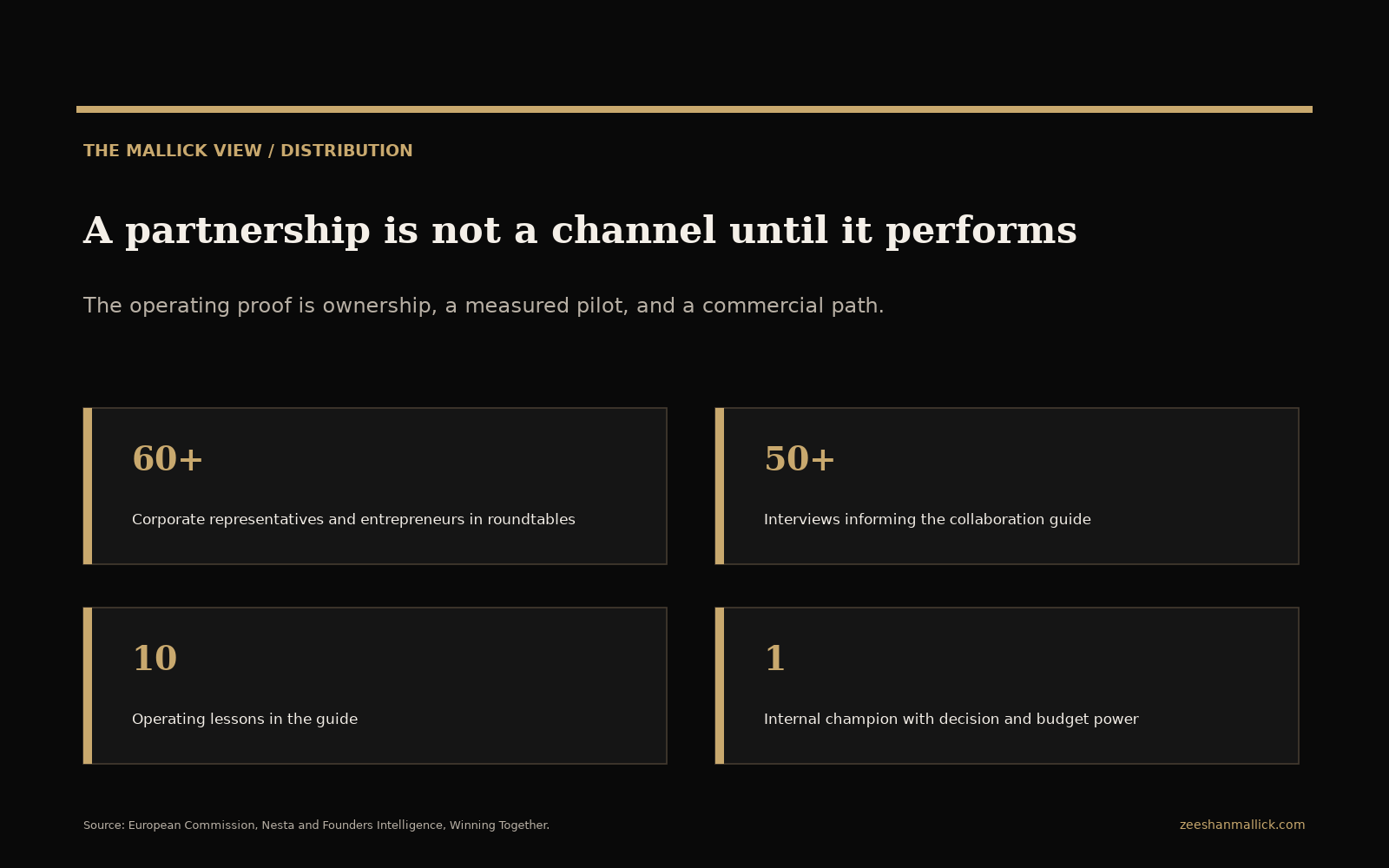
What founders should measure next
Operational checklist (concrete operator items founders should track now):
- Specific customer problem: Document the exact customer pain or job-to-be-done the partner will help solve. Record one-line problem statements and the customer segment affected.
- Named owner with decision and budget authority: Record the name, role, and explicit scope of authority for the corporate sponsor. Verify whether this person can approve budget and sign contracts or whether additional approvals are required.
- Measurable pilot definition: Agree and record pilot size, duration, success criteria, and the metrics to be measured. Use simple metrics tied to customer behaviour (e.g., number of customers onboarded, conversion from trial to paid, time-to-value) rather than vanity counts.
- Route to commercial delivery: Confirm the commercial terms and handoff process if the pilot succeeds. Record who will own pricing, procurement, contracting, and ongoing support.
- Timeline and decision gates: Agree milestone dates and a decision gate with explicit go/no-go criteria.
- Feedback capture: Define how customer and internal feedback will be captured and who will act on it.
- Resource commitment: List the internal resources (sales, product, customer success) and budget required to run the pilot and to scale if successful.
- Escalation path: Define how conflicts or blocks will be escalated and resolved within both organisations.
These are operator-level actions. Each item should be recorded in a single shared document or project board and assigned to a specific person.
Frequently asked questions
Q: If a corporate partner has brand recognition, is an announcement enough to call it a distribution channel?
A: Not by itself. Brand recognition can help lead generation, but a channel requires ownership, measurable pilots, and an agreed route to paid delivery. The guide repeats this logic: clarify objectives and develop KPIs before claiming a distribution outcome. See the guide: European Commission / Nesta guide.
Q: Who should be the named owner inside the corporate partner?
A: The named owner should be someone with budget authority and decision rights for the scope of the partnership. Appointing an internal champion with decision and budget power is one of the ten lessons the guide recommends. That person must be able to prioritise internal resources and sign commercial commitments.
Q: What if the partner refuses to define a route to commercial delivery?
A: Treat the engagement as a meeting and limit resource allocation. The guide warns that weak strategic alignment and lack of internal buy-in limit effectiveness. If the partner will not agree to a pilot with metrics and a route to commercial delivery, consider alternative uses of time and capital.
Sources
Continue the conversation
- Home
- Book Zeeshan
- Related: Feature Factory roadmap trap
- Related: SaaS services margin trap
- Related: CEO calendar growth tax
Master Collective Newsletter
Receive concise perspectives on founders, capital and strategic growth.