Your International Expansion Is Not a Growth Strategy. It Is a Compliance Cost Before It Is Revenue.
Expansion is often framed as a demand problem. This analysis reframes new markets as operating systems: legal, tax, labour, payment, and reporting capacity must be proven before marketing spend counts as demand.

Decision-led opening
International expansion is a structural operating decision, not a marketing experiment. Treating paid user acquisition or promotional spend as evidence of sustainable international demand skips the hard, recurring costs that make cross-border presence operable. This is not investment advice or legal/tax/accounting advice; it is an evidence-led operational argument aimed at founders, operators, and boards.
The decision
A founder facing a country-launch choice should decide first whether the organisation can operate in that jurisdiction — legally, fiscally, and administratively — at the scale anticipated. The decision is binary in the short term: is the company ready to support a fully functioning operating system in that country, or should the company run a limited, instrumented experiment designed to prove specific operational capabilities?
Evidence summary
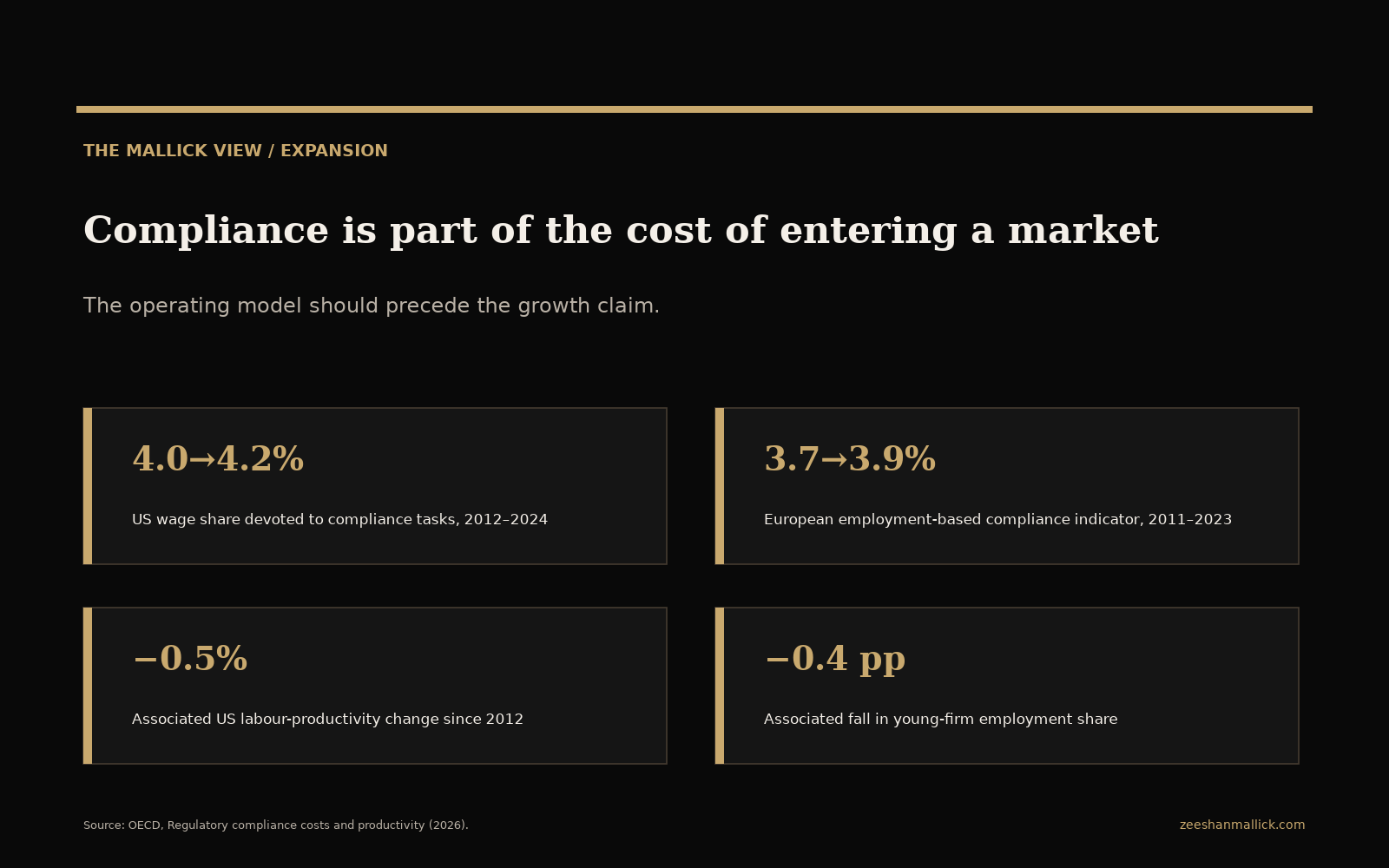
The operational costs of compliance are measurable and rising in rich economies. An OECD 2026 working paper estimates that the United States wage share devoted to compliance tasks rose from 4.0% in 2012 to 4.2% in 2024; its European employment-based indicator rose from 3.7% in 2011 to 3.9% in 2023. The same OECD state-level analysis associates the U.S. increase since 2012 with a 0.5% decline in labour productivity and a 0.4-percentage-point reduction in the share of workers employed in young firms. The OECD frames the policy implication as preserving social benefits while limiting unnecessary compliance burdens, rather than treating compliance as an optional administrative detail. See the OECD analysis for the full working paper and framing: https://www.oecd.org/en/publications/regulatory-compliance-costs-and-productivity_1c1da52e-en.html
These observations lead to three operational conclusions:
- The labour cost of compliance is not a fixed headline item; it scales and compounds with each additional jurisdiction where the business operates. That scaling shows up in wage share and employment indicators captured by the OECD.
- Rising compliance burden correlates, according to the OECD working paper, with measurable declines in productivity and a smaller share of employment in young firms — outcomes that materially affect early-stage scaling.
- Policy design matters: the OECD frames the right institutional response as balancing social protections with limits on unnecessary compliance burden, implying that business planning must account for regulatory design rather than assume it will be light-touch.
Why a market is an operating system, not a map pin
A market is a stack of operating requirements: a legal entity or registered presence, payroll and labour law compliance, tax registration and reporting cycles, payment rails and reconciliation, and statutory reporting. Each element requires procedures, decision rights, tooling, and ongoing staff time.
- Legal and entity setup shapes capital flows, contracts, IP ownership, and dispute resolution routes. That setup is often a multi-week process and once in place requires ongoing counsel and management.
- Tax and reporting create recurring cycle costs and create data obligations that shape product behaviour (invoice structure, VAT/service tax handling, withholding rules).
- Labour law and payroll determine hiring models, contractor usage, dismissal cost, benefits provisioning and local HR policy.
- Payments and banking restrict settlement timing, FX exposure and reconciliation effort.
If any single element is missing or weak, marketing-driven demand can convert into a sustained compliance burden and a drag on unit economics.
Single concise comparison table
| Element | Immediate operational need | Typical recurring cost type |
|---|---|---|
| Legal / entity | Registration, contracts, counsel | Ongoing counsel, entity maintenance |
| Tax / reporting | Registration, filing cadence | Reporting labour, tax filing, reconciliation |
| Labour / payroll | Local contracts, benefits | Payroll processing, compliance hours |
| Payments / banking | Merchant setup, local rails | Reconciliation, FX handling |
| Reporting / audit | Statutory reports, filings | Staff time, external fees |
Operational implications for expansion plans
- Marketing spend is not a substitute for operational readiness. Spending to discover demand before operational readiness can cause negative unit economics once compliance costs are included.
- Test designs should instrument operational hypotheses, not only demand hypotheses. For example, a launch test should measure payroll cycle time, tax registration time, payment settlement lag, and monthly reporting overhead as primary metrics alongside conversion rates.
- Leadership should budget for the incremental wage-share effect of compliance. The OECD analysis suggests compliance work has a measurable wage share and correlates with productivity outcomes; planning must internalise that compliance takes hours from employees and management.
Practical, evidence-led launch protocol
- Specify the operating system required for the product to function legally and commercially in the target market. Be explicit about entity type, payroll model, and required tax registrations.
- Build a short-run experiment that proves each critical operating capability with a minimal financial commitment: entity setup feasibility, payroll processing in the local currency, successful tax registration, and payment reconciliation.
- Measure the overhead in staff hours and recurring costs. Convert hours into a wage-share proxy for that jurisdiction inside your planning model.
- Only if operational KPIs are met should marketing acquisition budgets be unlocked at scale.
What founders should measure next
A concrete operator checklist to turn this argument into action:
- Entity readiness
- Time to register legal entity or appoint a local legal presence (days)
- One-off legal fees to establish and the monthly cost of maintenance
- Tax and reporting
- Time to complete first tax registration and first filing cycle (days/weeks)
- Number of recurring filings and expected staff-hours per filing
- Payroll and labour
- Time to onboard first local employee and process first payroll (days)
- Monthly hours spent on payroll compliance and benefits administration
- Payments and banking
- Time to obtain merchant settlement and first settlement lag (days)
- Monthly reconciliation hours and FX exposure tracking process
- Reporting and audit
- Time and cost to produce statutory month/quarter reports
- External fees for required audits or filings
Each item should be instrumented in one source of truth and tracked during any market experiment. Do not treat marketing conversion alone as the success criterion.
Frequently asked questions
Q: Does this mean companies should never run international marketing tests?
A: No. It means tests must be designed to validate operational capacity as well as demand. Marketing-only tests that ignore legal, tax, payroll, and payment realities risk producing misleading economics.
Q: Are compliance costs permanent overheads?
A: Compliance costs are recurring and can scale with the size and number of jurisdictions. The OECD analysis finds an increasing wage share devoted to compliance tasks in rich economies; planning should treat them as durable line items, not one-time fees.
Q: How should boards evaluate international expansion proposals?
A: Boards should require a short operational readiness plan with measurable KPIs: entity setup time, payroll and tax cycle times, payment settlement lag, and expected recurring staff-hours. Approve marketing spend only after those KPIs have been met or the experiment has demonstrated clear operational surmountability.
Sources
- https://www.oecd.org/en/publications/regulatory-compliance-costs-and-productivity_1c1da52e-en.html
Continue the conversation
Master Collective Newsletter
Receive concise perspectives on founders, capital and strategic growth.