You Are Not the Company. You Are the Bottleneck Until You Build a Transferable Operating System.
Founders must decide: stay the indispensable bottleneck or design an operating system that runs without the founder in every room. Evidence from a large longitudinal study shows replacement of single-founder CEOs is complex — both risk and opportunity — and the right response is practical transferability, not ritual replacement.

Publication date: 2026-08-31
The decision
The decision is direct: treat founder transition as a response to the company's current structural needs, not as a ritual that replaces personalities. When the company requires repeatable decisions, predictable customer handling, and knowledge that survives personnel changes, leaders must build a transferable operating system before stepping back. This is not investment, legal, accounting, or tax advice; it is an operational judgment grounded in evidence and clear trade-offs.
The evidence
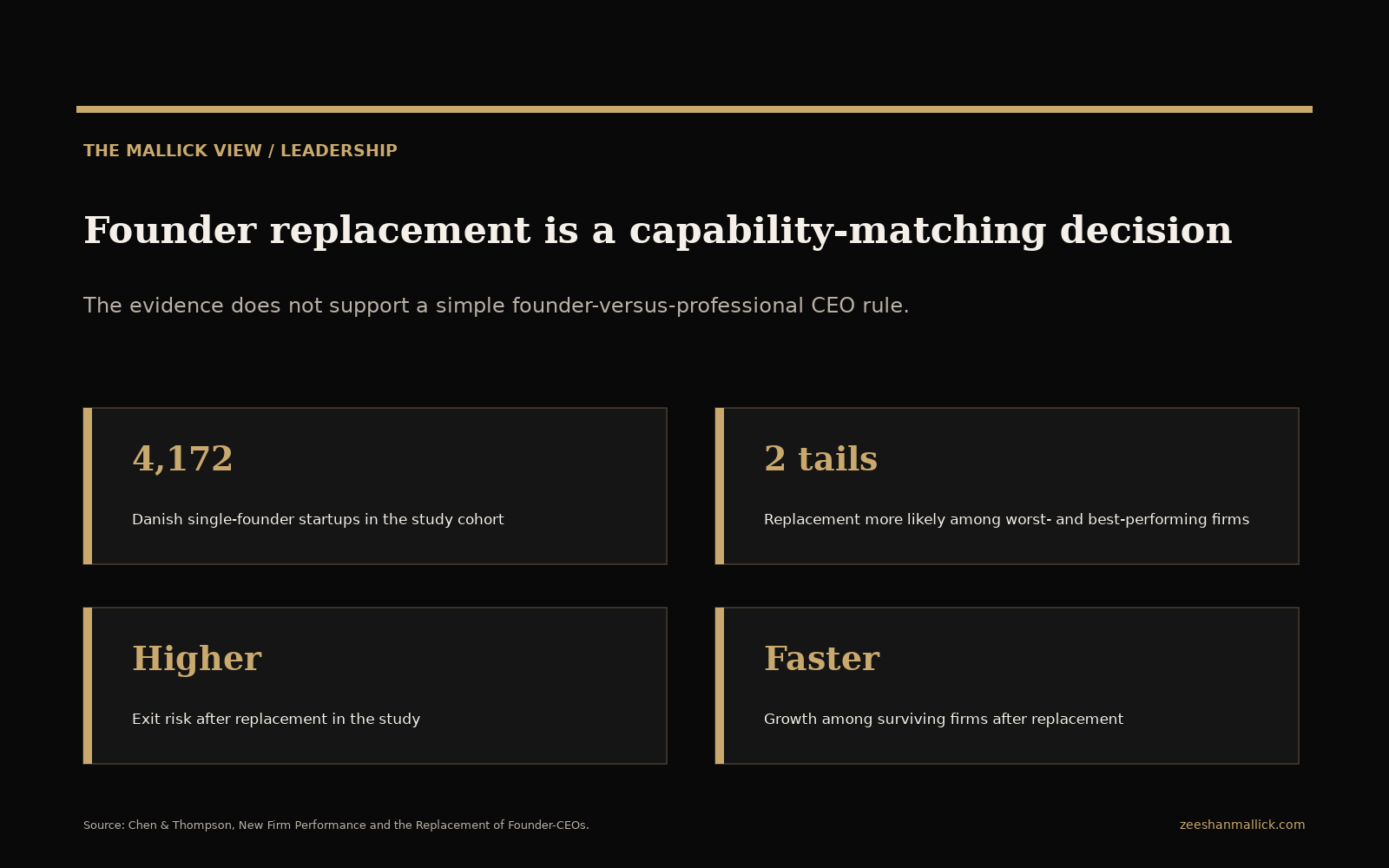
A rigorous study examined 4,172 Danish startups created by single founders in 1999 and 2000. The research found that founder-CEO replacement was more likely among both the worst- and best-performing firms; replacement was not unambiguously associated with better subsequent performance. Firms that replaced the founder were more likely to fail, while survivors among them grew faster, supporting a mismatch rather than a simplistic founder-versus-professional-manager narrative. The study is available here: Berkeley/Emory study.
Interpretation
The study supplies a clear anchor: replacing a founder correlates with two opposite outcomes. That pattern implies two possibilities in practice. One, replacement often signals underlying failure modes — the firm is already fragile, and change accelerates decline. Two, replacement can be the right fix for firms that outgrow a founder's informal systems, enabling survivors to scale faster.
Because the data do not show that replacement is uniformly beneficial, the operational test should be transferability of decisions and knowledge. The question is not whether a replacement will be hired; it is whether the organization can continue to make the same quality of decisions, serve the same customers, and preserve institutional knowledge when the founder is not in every room.
A framework for action
Operational leaders should evaluate three domains before changing founder roles: decision processes, customer continuity, and institutional knowledge. The framework is simple and practical:
- Decision processes: Are core strategic and tactical decisions documented, repeatable, and delegated to accountable owners? If not, the founder is the bottleneck.
- Customer continuity: Can customer-facing teams handle onboarding, escalations, and renewals without the founder intervening? If not, the company risks revenue when the founder steps back.
- Institutional knowledge: Is critical context codified in playbooks, runbooks, or onboarding materials? If not, knowledge departs with people.
A deliberate path is to build an operating system that makes each of these domains observable and transferable; only then is transition a choice rather than a forced replacement.
Comparison table
| State | Primary risk | Primary corrective focus |
|---|---|---|
| Founder-dependent company | Decisions and knowledge concentrated in one person; fragile to absence | Codify decisions, delegate authority, create playbooks |
| Transferable operating system | Possible short-term slower decisions as processes formalize | Scale through repeatability; measure handoffs and outcomes |
Practical next steps
Start measurable experiments that shift ownership of discrete decisions from the founder to named operators. Run short cycles: document the decision, assign responsible owner, execute twice, compare outcomes. If outcomes degrade, iterate on training and runbooks until quality stabilizes. This approach converts the abstract goal of ‘succession’ into an engineering problem of transfer and measurement.
Evidence-linked practice
The Berkeley/Emory study of 4,172 single-founder Danish startups (1999–2000) reminds decision-makers that founder replacement aligns with both failure and accelerated growth among survivors. Use that dual signal to avoid binary thinking: replacement is neither a panacea nor a condemnation. Instead, let evidence guide a staged transfer that proves the operating system before removing the founder from daily flow: document, transfer, measure, and only then expand the founder’s absence.
What founders should measure next
A concrete operator checklist to test transferability:
- Ownership coverage: list 10 core decisions (pricing changes, hiring for key roles, product priorities) and assign named owners for each.
- Decision reproducibility: for 5 recurring decisions, create a one-page decision protocol and run the protocol twice without founder involvement.
- Customer continuity metric: measure customer escalation time before and after delegation for a sample of 20 cases.
- Onboarding completeness: percentage of critical knowledge captured in playbooks covering role, decision rules, and escalation paths.
- Error and recovery rate: track how often delegated decisions require founder override and how quickly teams recover without founder input.
- Time-to-autonomy: target dates when specific decision categories move fully off the founder’s calendar.
These measures are operational levers. The numbers and rates do not need to be perfect; progress and reproducible outcomes matter.
Frequently asked questions
Q: When is founder replacement the right option?
A: Replacement is the right option when the company has reached a structural mismatch between the founder’s style and the repeatability the business needs, and when an evidence-based transfer trial shows persistent degradation despite attempts to codify and delegate. The Berkeley/Emory study shows replacement correlates with both failure and faster growth among survivors; the pattern indicates context matters.
Q: How to avoid accelerating failure when changing leadership?
A: Avoid abrupt, untested transitions. Use staged transfer: document processes, name owners, run transfers as experiments, and monitor the checklist metrics. If outcomes worsen, pause and reinforce the operating system rather than pushing full replacement.
Q: Can a founder stay involved but not be the bottleneck?
A: Yes. The key is that the founder’s involvement becomes optional rather than required. That means most decisions should be executable without the founder present; the founder focuses on unique high-leverage roles that truly require their voice.
Sources
Continue the conversation
- Home: The Mallick View
- Book a call: Book Zeeshan
- Related: Executive hire failure
- Related: CEO calendar and growth tax
- Related: Founder mental health crisis
Master Collective Newsletter
Receive concise perspectives on founders, capital and strategic growth.