Your Revenue Is Not Diversified Demand. It Is One Customer Away From a Crisis.
Headline ARR hides concentration risk. Before claiming repeatable growth, founders must disclose customer concentration, contractual resilience, and a credible path to diversification.

Your Revenue Is Not Diversified Demand. It Is One Customer Away From a Crisis.
This is not investment, legal, accounting, or tax advice. It is an evidence-led operational critique for founders and advisors.
The decision
Do not present a headline ARR as proof of durable demand without also showing how that revenue is distributed and protected. A single large customer can remove the cash that funds the company. The right decision is to disclose concentration metrics, show contractual resilience, and present a credible, measurable plan to diversify before claiming repeatable growth.
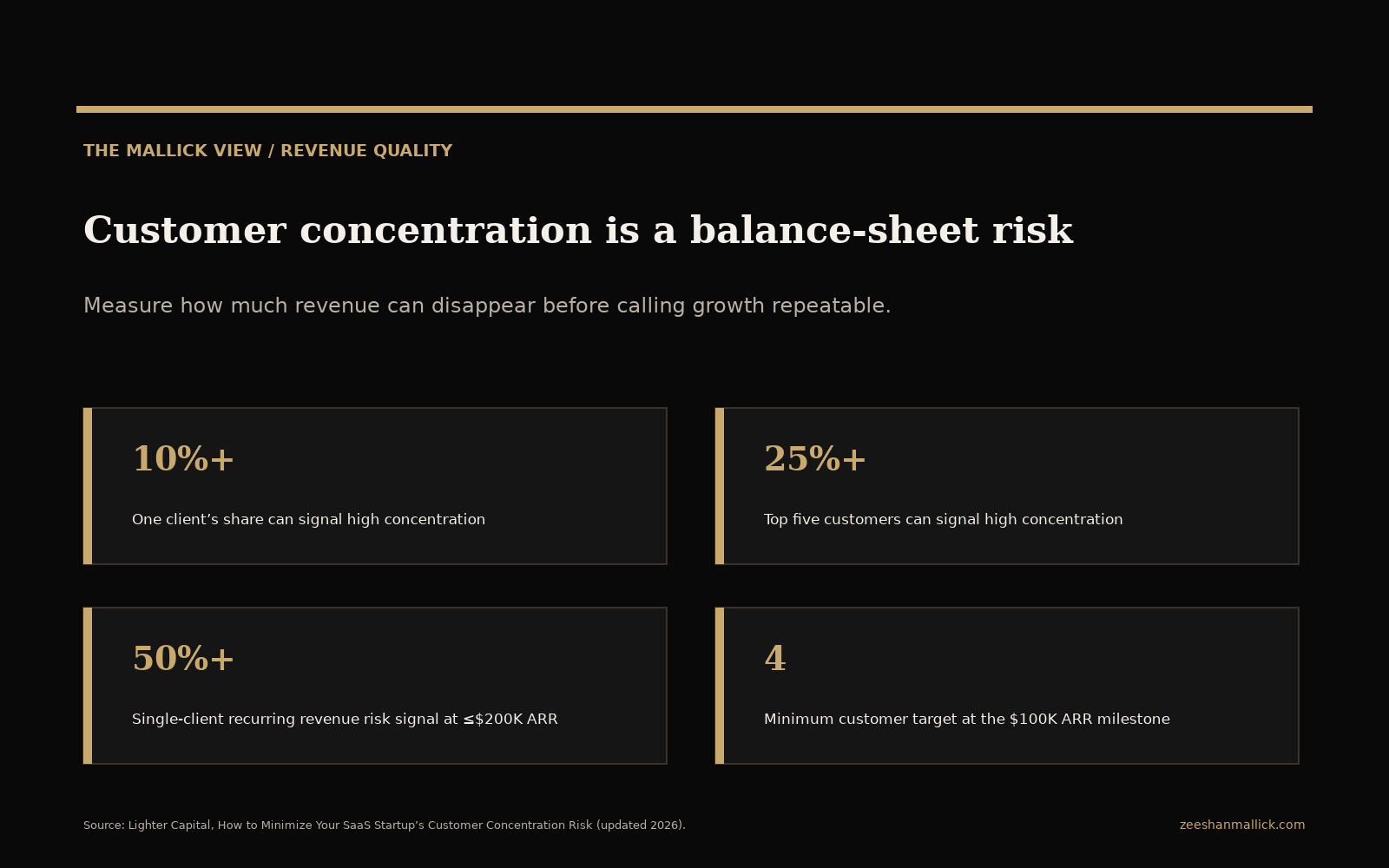
Evidence from a specialist operator source provides the concrete thresholds and the calculation method to make this decision measurable: calculate largest-customer or top-five revenue divided by total revenue. The source recommends that one customer accounting for more than 10% of revenue or five customers accounting for 25% may indicate high concentration. For early-stage SaaS with ARR of $200,000 or less, a single customer contributing more than 50% of recurring revenue is an explicit risk signal, and the same guidance proposes having four customers by the $100,000 ARR milestone as a minimum diversification target. The source also identifies three direct risks of high concentration: revenue vulnerability, less scaling flexibility, and a more difficult investor conversation (see the source link in paragraph below).
Being explicit about these metrics changes the conversation. A headline ARR number without concentration context is incomplete. The calculation method—largest-customer or top-five revenue divided by total revenue—turns a qualitative fear into a quantitative measurement that founders, board members, and operators can use to make short-term and strategic choices.
Read the guidance at the source for the exact thresholds and framing: https://www.lightercapital.com/blog/how-saas-startups-minimize-customer-concentration-risk
Why this matters now (operationally)
-
Revenue vulnerability: If one customer represents a large share of recurring revenue, the company’s cash flow and runway are exposed to that buyer’s procurement cycle, budget changes, or contract termination. That exposure is measurable with the concentration calculation above.
-
Less scaling flexibility: When growth depends on upsells or renewals with a tiny set of customers, product and sales choices must be tailored to those customers rather than to a broader market. That limits the company’s ability to scale repeatable playbooks.
-
Harder investor conversations: Investors evaluate not just ARR but the quality of that ARR. High concentration raises questions that must be answered with numbers and plans, not rhetoric.
These are the only factual thresholds and signals quoted from the source. Avoid asserting other percentages, benchmarks, or third-party examples that are not in the approved source.
| Signal | What to calculate | Why it matters |
|---|---|---|
| Single-customer risk (early-stage) | Largest customer revenue ÷ total revenue | >50% at ≤$200,000 ARR is a risk signal |
| Top-five concentration | Sum of top-five customers ÷ total revenue | >25% across five customers may indicate high concentration |
| Simple threshold | Single customer >10% | >10% from one client may indicate high concentration |
What founders should measure next
Concrete operator checklist:
- Compute: largest-customer revenue ÷ total revenue (monthly and trailing 12 months).
- Compute: top-five customers revenue ÷ total revenue (monthly and trailing 12 months).
- Record ARR bands: identify whether ARR is ≤$200,000 or near the $100,000 milestone and label concentration risk if thresholds are met.
- Contractual resilience review: list contract terms, notice periods, auto-renewal clauses, and early-termination penalties for top customers.
- Scenario modelling: run a cash-flow loss simulation for the loss of the largest customer and for a simultaneous loss of top-two customers; use only internal inputs.
- KPIs to track weekly: percentage revenue from top-1 and top-5; number of active customers; average recurring revenue per customer (ARPC); churn notices received this quarter.
- Diversification milestones: aim to reach the proposed four-customer milestone by the $100,000 ARR marker if applicable; set clear dates and sales actions to achieve that target.
- Board/Investors: prepare a one-page concentration statement that includes the concentration calculations, contract resilience summary, and the diversification plan.
Evidence discussion
The source defines customer concentration as the dispersion of revenue across the customer base and recommends the calculation method: largest-customer or top-five revenue divided by total revenue. It lists thresholds that indicate concentration risk (more than 10% from one client or 25% from five customers) and flags a specific early-stage signal (for SaaS at $200,000 ARR or less, one customer >50% of recurring revenue is a risk). The source also recommends a practical milestone: four customers by the $100,000 ARR stage as a minimum diversification target. Finally, the source names three operational risks tied to concentration: revenue vulnerability, less scaling flexibility, and a more difficult investor conversation.
Those statements are the factual foundation. From that base, the editorial framework recommends transparency and measurable milestones. Any public statements about ARR should be accompanied by the concentration numbers and a summary of contractual protections. That reduces ambiguity and puts the burden of proof on claims of repeatability.
Frequently asked questions
Q: How should a founder present concentration numbers to investors?
A: Present the largest-customer ÷ total revenue and top-five ÷ total revenue for both current month and trailing 12 months, disclose key contract terms for each top customer, and include a one-paragraph plan with dates to reduce concentration. This keeps the conversation numeric and action-focused.
Q: Is ARR meaningless if one customer is large?
A: ARR still measures recurring revenue, but headline ARR alone is incomplete. If one customer makes up a large share, ARR does not reflect resilience. Use the concentration calculations to qualify ARR.
Q: What if a startup already has a single customer >50% at ≤$200,000 ARR?
A: Treat it as a risk signal. Follow the checklist above: model loss scenarios, accelerate diversification actions, and document contractual protections. The source suggests aiming for four customers by the $100,000 ARR milestone as a practical diversification target.
Sources
- https://www.lightercapital.com/blog/how-saas-startups-minimize-customer-concentration-risk
Continue the conversation
Master Collective Newsletter
Receive concise perspectives on founders, capital and strategic growth.