Your AI Pilot Is Not Customer Demand. It Is a Cost Until the Workflow Changes.
AI pilots often read like product announcements. The true test of customer demand is a repeatable workflow, a named owner, measurable outcomes, persistent adoption, and the full cost of delivery. Without these, pilots are costs, not proof.

Your AI Pilot Is Not Customer Demand. It Is a Cost Until the Workflow Changes.
Decide quickly: treat an AI pilot as an operating cost until it proves a repeatable, owned workflow with measured outcomes. This is not legal, tax, or investment advice. It is an operational rule: demonstration alone is not product-market fit.
The decision
Founders and operators must stop treating pilot deployments and demos as evidence of product-market fit. The decision is simple and immediate: require five elements before counting AI as real customer demand.
- A specific workflow that the AI enables or replaces.
- An accountable owner inside the customer organization.
- A measured outcome that matters to that owner.
- Demonstrated persistence in adoption beyond the pilot phase.
- Full visibility of the cost to deliver and maintain the AI solution.
These elements turn a pilot into a business metric. Absent them, the pilot is a cost center.
Evidence and constraints
Enterprise AI is hampered by specific, named constraints. IBM identifies data readiness, governance and security, ROI measurement, skills and organizational change, and workflow integration as limits to scale. These are not vague obstacles; they define where pilots commonly fail to become persistent customer demand. See IBM’s analysis for the full list: https://www.ibm.com/think/insights/ai-adoption-challenges.
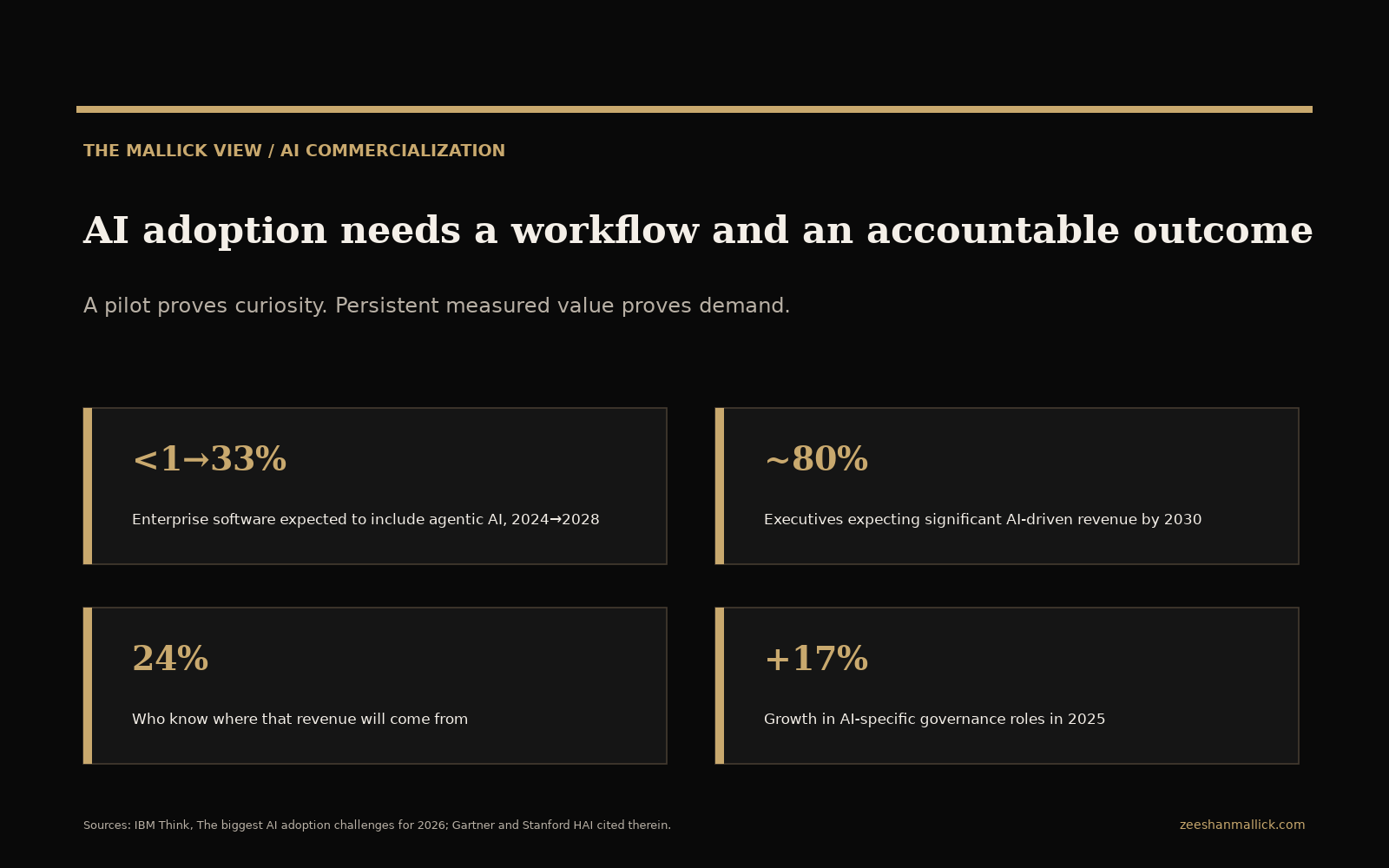
IBM also cites a forecast from Gartner: 33% of enterprise software applications will include agentic AI by 2028, up from less than 1% in 2024. That projection is a platform and product expectation, not proof that individual pilots are matched to customer workflows.
Further, IBM reports that nearly 80% of executives expect AI to drive significant revenue by 2030, while only 24% know where that revenue will come from. IBM additionally notes AI-specific governance roles grew 17% in 2025. These numbers show a gap between expectation and operational clarity. They are indicators that many organizations plan for AI but have not yet closed the loop between pilot and persistent customer value.
Use these facts to set guardrails. Treat forecasts and executive expectations as signals — not substitutes — for direct evidence that customers changed how they work and are willing to pay for it.
Why a pilot is usually a cost
A pilot demonstrates capability. It may reduce risk or impress stakeholders. But demonstration alone leaves critical questions unanswered:
- Who will run the workflow day-to-day?
- Who pays for the incremental engineering, data pipelines, and governance?
- What metric will show the pilot moved the needle for the customer?
- Will usage continue after the engineering handoff?
If answers are missing, the pilot consumes budget and attention without converting to recurring revenue. The IBM list (data readiness; governance and security; ROI measurement; skills and organizational change; workflow integration) explains where costs pile up and why persistence is rare. Link: https://www.ibm.com/think/insights/ai-adoption-challenges.
Comparison: Pilot vs Workflow Change
| Criterion | Pilot (demonstration) | Workflow Change (business demand) |
|---|---|---|
| Owner | Often technical sponsor | Named operational owner |
| Outcome | Prototype metrics or demos | Measured impact tied to business metric |
| Persistence | Limited to project period | Repeated daily/weekly use |
| Cost visibility | Partial, often on vendor | Full life-cycle cost known |
| Risk | Technical risk shown | Operational and governance managed |
This table makes the decision practical: count the right column, not the left.
What founders should measure next
Operational checklist for turning pilots into customer demand:
- Identify the workflow. Record the step-by-step process the AI will change. Name the inputs, outputs, and handoffs.
- Name the accountable owner inside the customer organization. Get their title and commitment to a metric.
- Define one measurable outcome tied to the owner’s incentive (revenue, time-to-decision, error reduction). Quantify baseline and target.
- Track adoption persistence: measure weekly active users or completed workflow runs for at least 12 weeks post-pilot.
- Calculate full delivery cost: initial implementation, data pipeline upkeep, monitoring, security, and support for a 24-month horizon.
- Map governance points: who approves data use, who signs off on model updates, and who handles incidents.
- Plan for skills transfer: list roles and training necessary inside the customer org to sustain the workflow.
- Require a pay trigger: identify the payment or contracting event that scales beyond the pilot.
Each item must be documented and agreed in writing before the pilot is counted as customer demand.
Evidence discussion complete.
Frequently asked questions
Q: If many executives expect revenue from AI, why not treat pilots as demand?
A: Expectation is not evidence. IBM reports nearly 80% expect AI to drive significant revenue by 2030, but only 24% know the source. Expectation without a named workflow and measured outcome leaves pilots as speculative spend.
Q: How long should persistence be measured before calling it demand?
A: Measure sustained usage across a meaningful window. A practical threshold is 12 weeks of repeat use after pilot handoff, with a clear business metric showing impact.
Q: What if the customer lacks the skills or governance to keep the workflow running?
A: Then the pilot remains a cost. IBM lists skills and organizational change plus governance and security among constraints to scaling enterprise AI. These must be addressed before the pilot converts to demand.
Sources
Continue the conversation
Master Collective Newsletter
Receive concise perspectives on founders, capital and strategic growth.